
Are you considering buying a used Honda CRF230F but wondering if it's still a good dirt bike? Whether you're a beginner looking for your first trail bike or an experienced rider who wants something easier to ride, the CRF230F might surprise you.
I've owned two CRF230Fs, including my 2005 model that I've been riding since 2017. I've ridden it on tight Minnesota single-track trails, raced it in hare scrambles and enduros, and taken it into the mountains of Colorado and Montana.
My verdict: The CRF230F is one of the best trail bikes I've ridden for tight, technical trails—especially for beginners and shorter adults. It has smooth, tractor-like power, a low center of gravity, and excellent reliability.
But it's not perfect. The stock suspension is its biggest weakness, and it's not the best choice for fast, rough trails or motocross.
In this review, I'll explain what I like and dislike after years of ownership, what to look for when buying one used, and whether the CRF230F is still worth buying today.
Prefer to watch a video review? If not, keep scrolling for the rest of this article.
Is the Honda CRF230F a Good Dirt Bike?
Yes. The CRF230F is an excellent trail bike for beginners and experienced riders who prefer slower, tighter trails.
It's especially good for:
- Adults around 5'4"–5'10" who want a lower seat height with full-size wheels
- New riders who want smooth power and an easy-to-control clutch
- Woods riders who prioritize comfort, reliability, and low-speed handling
However, I'd consider a different bike if you're very lightweight, over 6 feet tall and want a roomier cockpit, or regularly ride fast, rough trails.
My favorite feature: The CRF230F is so easy to ride that I can often ride longer and more comfortably than on more powerful dirt bikes. With upgraded suspension, my 2005 CRF230F is still my favorite bike for Minnesota single-track trails.
Engine - 223cc putting power to the ground
The CRF230F's 223cc air-cooled engine is one of the biggest reasons I still love riding this bike after all these years.
It doesn't have a lot of horsepower, but it has surprisingly good torque right off idle. Combined with its low first gear, it feels almost like a tractor, allowing you to crawl through tight, technical trails without constantly slipping the clutch.
I've ridden my CRF230F on everything from tight Minnesota single-track to rocky mountain trails in Colorado and Montana. For most of that riding, I've rarely wished it had more power.
That's what makes this engine so good for beginners and experienced woods riders alike: It's smooth, forgiving, and easy to control, so you can focus more on the trail instead of managing the engine.


Why the CRF230F's Simple 2-Valve Engine Works So Well
It has a 2-valve cylinder head - an old-school design that still works for a couple of reasons. There are fewer moving parts, making it simpler and more reliable, but it also provides better low-end torque.
It won't flow as much air (which is needed for peak HP), but it has very good velocity at low RPM. This is the reason why it has such good torque right off of idle, which makes it easier to use the clutch as a new rider.
The power delivery is extremely forgiving, which is super important if you're learning how to ride off-road. The power dies off after 8k RPM, so there's no point in revving it that high.
CRF230F Horsepower: Is 18 HP Enough?
A stock engine has about 18 horsepower, which is okay, but that's not the most important number. As I just covered above, you want to look at the power numbers below the peak.
In fact, if you're looking at a dyno chart, some of the most important numbers aren't even recorded (1500-3000 RPM) because dynamometers can't accurately record them.
I've been able to keep up with riders on much more powerful 300cc two-strokes and 450cc four-strokes in tight Minnesota woods. My CRF230F has upgraded suspension, but the engine still has plenty of usable power for this type of riding. On faster, more open trails, however, the lack of horsepower becomes much more noticeable.
CRF230F Top Speed: How Fast Does It Go?
The top speed of a stock CRF230F is about 60 mph, which isn't very important either because you never reach max speed unless you're riding on flat ground for a long distance. If you need to go faster or accelerate faster, just change the sprocket size (Amazon).
Engine mods for performance
There are plenty of engine mods for the CRF230F if you get bored. Anything from a high compression, big bore kit, to a modified flywheel key to advance the timing.
You can turn your little 'girly bike' into a sleeper trail bike that will make riders with $11k bikes cry in the woods. But, the engine isn't the weakest link - I'll cover that shortly...
CRF230F Jetting
Just like any other dirt bike, tuning the carb jets and needle circuits is paramount to getting it to run its best. It will also help if your dirt bike is hard to start or running poorly.
The CRF230F comes jetted lean from the factory due to EPA/California laws, but that's easy to correct. If you're leaving everything stock, you just need a couple of jets and maybe a needle (for 2006+ models) to get it to run well.
Stock jetting is a 42 pilot and 102 main jet. If you've uncorked the intake and/or exhaust, then you'll want to bump up to a 45 pilot jet and a 105 or 110 main jet. Then you'll have to tweak the fuel screw for best starting and throttle response.


CRF230F Suspension – Is It Any Good?
The stock suspension is probably the CRF230F's biggest weakness, especially if you're an experienced rider who likes riding faster over rough terrain.
However, it's perfectly adequate for most beginners and casual trail riders who aren't pushing the bike very hard.
I've ridden my CRF230F with both the stock suspension and upgraded suspension, and the difference is substantial.
Front Forks
The stock CRF230F forks are fairly basic and don't have external damping adjustments.
One thing I noticed is that they feel surprisingly harsh over small bumps and roots, yet they can still bottom out fairly easily on bigger impacts.
For casual riding at slower speeds, they're usable. But as you become more experienced and start riding faster, their limitations become more noticeable.
I modified my stock forks with different springs and damper modifications, which made them noticeably plusher over small bumps while also improving bottoming resistance.
Rear Shock
The stock rear shock is even more limiting than the forks, in my experience.
The biggest problem isn't necessarily the spring stiffness—it's the damping, particularly the slow rebound.
When you hit several bumps in a row, the shock may not extend quickly enough before the next bump. This causes the suspension to progressively compress, which is known as packing.
When the shock finally has enough time to extend, it can upset the bike's balance and potentially throw your weight forward.
I've found this becomes especially noticeable when riding aggressively over rough terrain or whoops at around 15 mph or faster.
For beginners riding slowly, it's generally not a major concern.
The stock shock only offers spring-preload adjustment, so there's limited ability to improve its damping without modifying or replacing it.
Is Upgrading the CRF230F Suspension Worth It?
If you're a beginner, I'd recommend riding the stock suspension first. You may find it's perfectly adequate for your needs.
But if you're an experienced rider who enjoys tighter, more technical trails at a faster pace, upgrading the suspension can make a huge difference.
I upgraded my forks and installed a specially tuned Fox rear shock on my 2005 CRF230F. The Fox shock is no longer available, but the improvements in comfort, control, and handling are a big reason I still love riding this bike.
For the specific upgrades I've tried and which ones are worth the money, read my CRF230F Mods Guide.
Handling characteristics
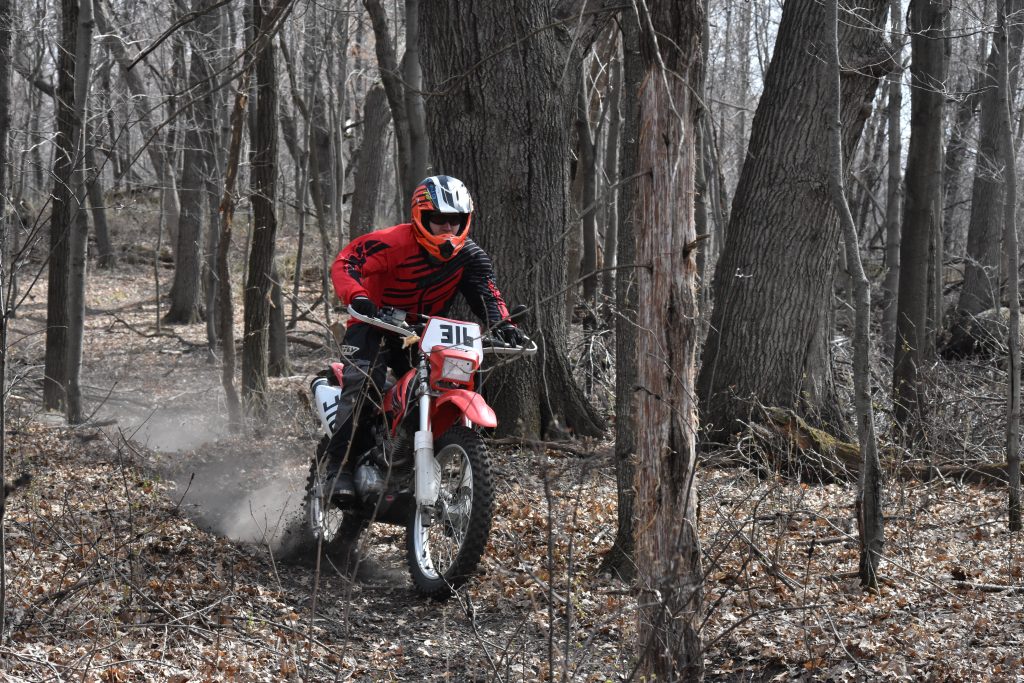
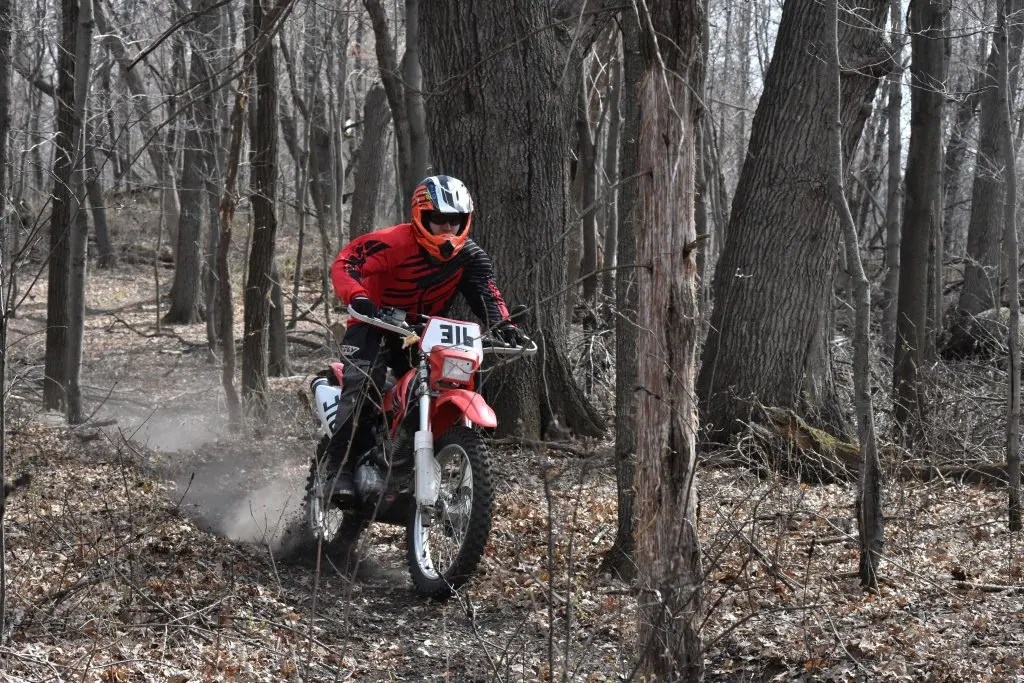
Although suspension plays a role in handling, the actual geometry of the chassis is the most important factor. The CRF230F handles very well where there are tight turns and obstacles. This is partly because it's in between a midsize and full size dirt bike.
The CRF230 has full size wheels (21/18"), but the seat height is much lower than a typical full-size bike. This creates a low center of gravity, which is great for cornering.
Mini woods weapon?
The short wheelbase also makes it turn more easily. Compared to driving a full size truck, the CRF230 handles like a compact car at low speeds.
These handling characteristics are the reasons why the CRF 230 is such a potent trail bike in the woods when properly set up for you.
Seat height - what size rider?
As previously mentioned, the 230F is smaller in size than most full size bikes. The seat height of 34.1" makes it a very beginner friendly off-road motorcycle if you're a new or shorter rider in the 5'3"-6'0" height range.
The only major downfall is the lack of ground clearance. Since the suspension travel is less and the chassis is smaller, the frame and pegs will drag more easily in ruts or on logs.
This is only a concern if you're riding technical terrain that has deep ruts or big logs.
Weight
When you see the wet weight of 249lbs, you wonder if that's going to be an issue. Surprisingly, there's really only one time when you will suffer from the CRF230 being rather heavy for its size. This is when you tip over and it's tough to pick it back up.
With that said, it's actually easier to pick up than most full size bikes because of the low center of gravity. A bike with a low CoG will naturally take less work to stand up because its total height is closer to the ground.
Model Year Changes
From 2003 to 2019, there weren't many changes to the CRF230F. Other than bold new graphics each year
- 2003: First year of the Honda CRF230F trail motorcycle
- 2006: The carburetor received a non-adjustable needle
- 2008: The gas tank got slightly smaller (thanks, Honda!). The seat is also slightly narrower.
- 2015: The plastics got a complete update in 2015.
- 2019: Last year of the Honda 230cc trail dirt bike


Is the Honda CRF230F Reliable? Common Problems to Know
The Honda CRF230F is one of the most reliable trail bikes I've owned. With basic maintenance, these engines can last decades for the average recreational rider.
In fact, one of the biggest problems is that they're so reliable that owners sometimes get lazy with maintenance!
The two things I always check first on a used CRF230F are the engine oil and air filter. Dirty or low oil can cause excessive engine wear, while a neglected or poorly sealed air filter can allow dirt into the engine.
Another common issue is hard starting or poor running after the bike has been sitting for months. This is often caused by old gasoline leaving deposits in the carburetor, clogging the jets or small fuel passages.
I've found that the CRF230F runs fine on regular 87-octane pump gas, but I recommend using fresh fuel and properly preparing the bike for storage. Ethanol-blended fuel can create additional storage problems, especially when moisture is present.
My advice: Don't assume a hard-starting CRF230F needs an engine rebuild. Check the fuel system and carburetor first, while also verifying the engine's mechanical condition.

CRF230 won't start
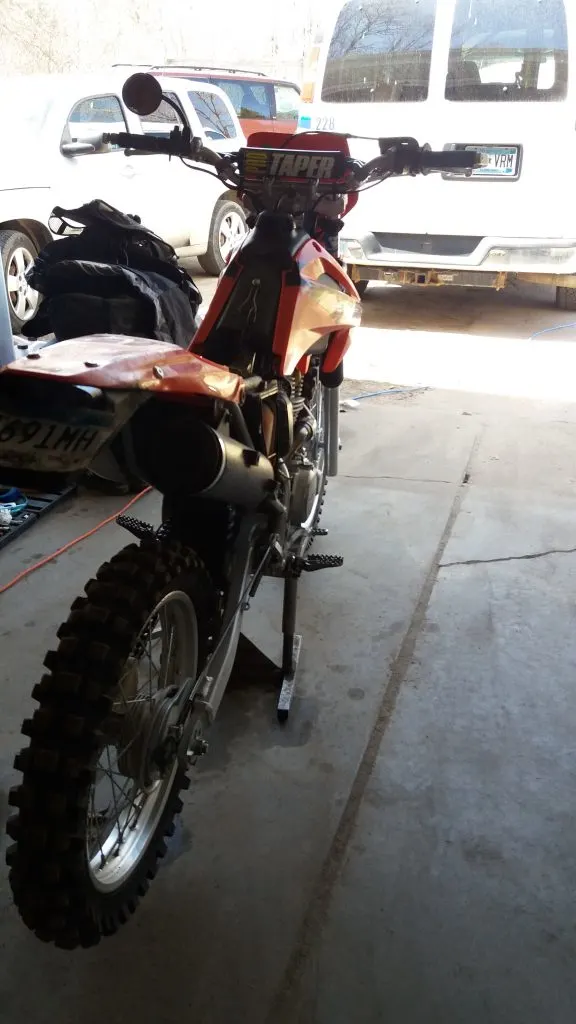
Although it's not a common issue, it can be hard to start due to sitting for too long or a lack of maintenance.
These are the most common reasons why your Honda CRF 230 won't start:
- Air filter dirty
- Jetting too rich or lean
- Carburetor jets clogged
- Weak or dead battery
- Broken wire or bad ground connection
Is a Used CRF230F Worth Buying?
Yes! I'd still recommend buying a clean, well-maintained CRF230F today, even though Honda discontinued it after 2019.
I've owned a 2003 and 2005 CRF230F, and I'd rather buy an older one in good condition than a newer one that's been neglected.
How Much Should You Pay for a Used CRF230F?
In my area, I'd expect to pay roughly $2,200–$2,800 for a clean CRF230F, depending on the year and condition. Your local market may be different.
The CRF230F didn't change much mechanically throughout its production, so I wouldn't pay significantly more just because a bike is newer.
What to Check Before Buying
Here are the biggest things I'd look for:
- Engine oil and air filter: Are they clean and properly maintained? Neglect here can indicate bigger problems.
- Engine smoke: Persistent blue smoke after warming up can indicate worn internal engine components.
- Starting and running: Hard starting or bogging may indicate a dirty carburetor, but could also point to engine problems.
- Compression: If I suspect engine wear, I'd perform a compression test before buying.
- Wear items: Check the tires, chain, sprockets, brakes, and suspension. These may not be deal-breakers, but they affect what I'd pay.
If a bike runs well and only needs routine maintenance or replacement wear items, I'd consider negotiating several hundred dollars off the price.
However, I'd walk away from a CRF230F with signs of major engine damage unless it was extremely cheap and I was prepared to rebuild it.
Which CRF230F Years Are Best?
Most model years are very similar mechanically, so condition matters more than the year.
One difference worth knowing is that the 2003–2007 models have a 2.2-gallon fuel tank, while 2008–2019 models have a 1.9-gallon tank.
I typically get around 30–40 MPG during casual trail riding, so the larger tank on the older bikes is a nice bonus for longer rides.
Can The CRF230F Be Made Street Legal?
A CRF230F can be made street legal in many states, but restrictions vary by state.
The typical requirements to make a CRF230F legal are:
- Headlight
- Tail/brake light
- Mirror
- Horn
- DOT legal tires
- Turn signals (State dependant)
- Legal muffler
Please refer to your state laws and regulations on how to get an off-road dirt bike plated. Read this guide for more in-depth instructions on how to make a dirt bike street legal.
A better dirt bike to ride on the street would be the CRF250L for comparison.
Honda CRF230F Specs
| CRF230F | |
| Manufacturer | Honda |
| Years Made | 2003-2019 |
| Engine | 223cc air-cooled 4 stroke |
| Compression Ratio | 9.0:1 |
| Transmission | 6-speed, manual clutch |
| Suspension Travel (Front/Rear) | 9.5"/9.0" |
| Wheel & Tire Size (Front/Rear) | 21/18" |
| Wheelbase | 54.1" |
| Seat Height | 34.1" (86.6cm) |
| Curb Weight (Full of fluids) | 249lbs |
| Fuel Capacity ('03-'07/'08+) | 2.2/1/9 gallon (0.4 reserve) |
| Ground Clearance | 11.7" |
| Horsepower | 18 HP |
| Top Speed | 60 MPH |
How To Shorten A CRF230F
Lowering the CRF230 is possible and a good option for shorter riders that want a full-size bike.
The easiest ways to shorten a CRF 230 are shaving the seat foam and installing a lowering link.
A lowering linkage does affect the rear shock geometry, but this change is minimal if the forks are lowered to compensate. You can always go back to the stock height after you gain experience and confidence in your riding.
Lowering The Forks
The seat height can also be shortened by lowering the suspension.
The forks can be lowered by pulling them up in the triple clamps. You can also add an internal spacer to reduce travel, lowering the forks.
Lowering The Shock
The shock preload can be changed to lower the rear of the bike. An internal spacer can be added to the shock as well, but it's a lot more work. That's why a lowering link is much easier to lower the rear.
How To Make A CRF230F Taller
There's plenty of taller riders that enjoy their little 230F. If you're over 5'6" and are debating whether this bike will fit, here's some mods that will make the cockpit less cramped.
Bar Swap
Tall handlebars are an easy mod to make your CRF230F feel taller. A different bar bend may be more comfortable for you anyway over the stock bars.
Bar Risers
Adding bar risers can make an even bigger difference to the ergonomics. Not only can the bars be taller, but you can move the handlebars forward as well with the right kind of risers.
With this mod you may have to swap out the brake line and clutch cable for longer ones if it's too far of a reach.
Taller Seat
Going to an aftermarket seat will raise the seat height. The stock seat is fairly stiff, so having more foam can make for a plusher ride on your backside.
Footpeg Relocation
The stock footpegs are pretty narrow and close to the seat. This makes it very cramped if you have long legs.
Going to an aftermarket footpeg will increase the width for more stability. Adding or making a relocation bracket to lower and move the pegs rearward makes a big difference in the size of the cockpit.
Best CRF230 mods
Want to make your CRF230F faster? There's so many mods available, such as an aftermarket exhaust, piston, and jet kit. But which ones will actually make a difference without spending a fortune?
The best ones for your money are:
- Un-corking
- Rejetting
- Suspension tuning for your weight and skill
CRF230F vs CRF250F vs TTR230 vs XR200: Which Is Better?
I've owned or ridden all four of these trail bikes, and each has advantages depending on what you're looking for.
CRF230F vs CRF250F: The CRF250F has noticeably better power at higher RPM and excellent fuel injection, which makes starting and throttle response nearly effortless. However, the CRF230F feels considerably lighter, which I prefer for tight, technical trails.
CRF230F vs TTR230: These bikes are very similar in performance and handling. In my experience, the CRF230F has slightly better torque right off idle and substantially more aftermarket upgrade options. Either is a great beginner trail bike.
CRF230F vs XR200R: The XR200R is lighter and can be even easier to ride, but the CRF230F has electric start and slightly more modern ergonomics. The 1986–1991 XR200R also has better stock suspension, while the 1993–2002 models have suspension that's comparable to or worse than the CRF230F.
My recommendation: I'd choose the CRF230F for tight woods riding and its combination of low-end torque, manageable size, and reliability. If you want fuel injection and a little more power, the CRF250F is worth considering. If you're shopping used, I'd prioritize condition over brand or model year.
CRF230 vs XR200
Final Verdict: Is the Honda CRF230F Still Worth Buying?
Absolutely. The CRF230F is still one of my favorite trail bikes, even after owning and riding much more powerful dirt bikes.
Its smooth low-end power, low seat height, and predictable handling make it an excellent choice for beginners and shorter adults. But with properly upgraded suspension, it can also be a surprisingly capable bike for experienced riders on tight, technical trails.
I've kept my 2005 CRF230F since 2017 because it's simply one of the easiest and most enjoyable bikes I've ridden in Minnesota woods.
Just remember that it's not designed for motocross or high-speed, rough trails, and a neglected used bike can quickly become an expensive project.
The CRF230F Is For:
- Teens that want a shorter full-size dirt bike
- Girls transitioning from a smaller bike
- Adults who want an easy-to-ride beginner bike
- Riders who like modifying underestimated bikes
The CRF230F Is NOT For:
- Motocross racing
- Riders wanting a high-tech dirt bike
- The best suspension and a lot of ground clearance
What Should You Read Next?
Already own a CRF230F and want to improve it? Check out my CRF230F Mods Guide for the upgrades I've personally tested.
Considering a newer Honda? Read my CRF230F vs CRF250F comparison to see which bike better fits your riding style.
Still deciding which trail bike to buy? Check out my Best Beginner Dirt Bikes Guide to compare other options.
Not sure what size bike you need? Get my Free Dirt Bike Size Chart before buying.

stalen su
Thursday 16th of July 2026
we are the dirt bike modified cnc parts factory in china, we can supply the front fork sets, handle bar , handle lever , foot peg , brake shift, gear shift, hub , rim and spoke sets. high quality and best price