
I've owned, ridden and modified CRF230Fs extensively, from simple carb jetting and suspension changes to upgraded forks, shocks, carbs, exhaust and engine modifications.
But I wouldn't start by buying performance parts.
If your stock CRF230F is hard to start, won't idle cleanly or doesn't run properly, get the stock carburetor dialed in first. There's no point adding an exhaust or opening the intake when the engine isn't properly tuned in stock form.
Once it's running correctly, the next upgrade I'd make depends on the rider. If you're an adult or aggressive trail rider and constantly bottoming the soft stock suspension, I'd fix the suspension before adding more horsepower.
After that, uncorking the intake and exhaust can wake up the engine—but increased airflow usually means you'll need to rejet the carb again.
I've tried most of the popular CRF230F mods below, so I'll show you what I'd actually do first, which upgrades work well together, and when it makes more sense to leave the bike alone.
Best CRF230F Mods at a Glance
| Your goal/problem | What I'd do first | My take |
|---|---|---|
| Hard starting / poor idle / bogging | Dial in stock carb jetting | Do this before mods |
| Suspension bottoms easily | Springs + suspension setup | Best upgrade for heavier/aggressive riders |
| More power from stock engine | Uncork intake/exhaust + rejet | Good inexpensive performance upgrade |
| Better suspension on a budget | Springs + fork oil/damping setup | Good starting point |
| Much better suspension | Bruce Triplett forks / fork conversion + shock | Big improvement |
| Better throttle response/performance | PWK28 or pumper carb | Worthwhile performance build |
| More power | Full exhaust + carb/intake tuning | Works best as a package |
| More low/midrange torque | ProCom CDI | Useful later-stage upgrade |
| More torque/power | High-compression or big-bore engine | Later-stage modification |
Which CRF230F Mod Should You Do First?
If your CRF230F isn't starting, idling or running properly, don't start by buying performance parts. Get the stock carburetor properly tuned first.
If it already runs well, your next upgrade depends on what's holding the bike back.
For an adult or aggressive trail rider who's constantly bottoming the suspension, I'd put money into the forks and shock before adding horsepower. More power won't help if the suspension can't keep the bike under control.
If the suspension works for your weight and riding style, then uncorking the intake/exhaust and properly rejetting the carb is one of the best inexpensive ways to wake up a stock CRF230F.
If you're building a sleeper 230F and want substantially more performance, that's when I'd start looking at upgraded suspension, a larger carb, full exhaust, CDI and engine work.
Not sure whether the CRF230F itself is right for you?
→ Read my Honda CRF230F review before spending money modifying it.
#1 — Properly Jet the Stock Carburetor
Before modifying anything else, make sure the stock carburetor is actually tuned correctly.
A CRF230F that's hard to start, won't idle consistently, bogs or doesn't respond cleanly to the throttle doesn't necessarily need a bigger carb or aftermarket exhaust. The stock carb works surprisingly well when it's clean and properly jetted.
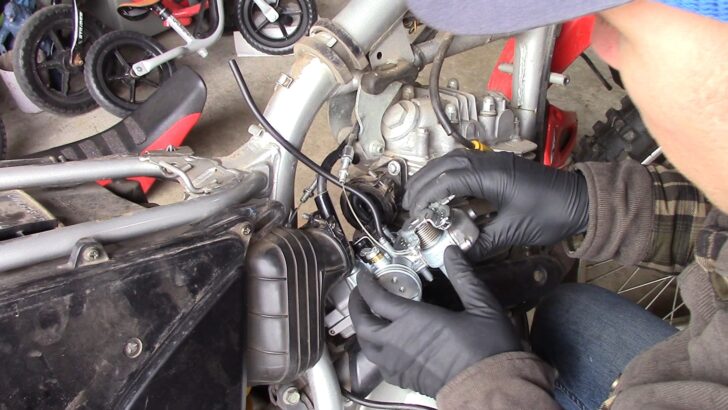
This is especially important because changing the intake or exhaust changes the amount of air flowing through the engine—which usually means the carburetor needs to be tuned again.
I wouldn't blindly copy someone else's jet sizes, either. Elevation, temperature, intake/exhaust modifications and the individual bike all affect what it needs.
My rule: Get it running correctly in stock form first. Then make one performance change at a time and tune the carb based on how the engine responds.
Trying to tune your CRF230F carb?
The fuel screw can tell you a lot about whether the pilot circuit is actually right.
Get my free 4-stroke fuel screw tuning guide →
What About the CRF230F "Power-Up" Jetting?
You'll often see the old Honda "Power-Up" jetting recommended for the CRF230F. It can be a useful starting point, especially after uncorking the bike, but don't treat somebody else's jet sizes as the final answer for your bike.
Different needles also require different main-jet sizes, so comparing jet numbers without knowing which needle is installed can be misleading.
For reference, common setups include:
- Stock 2003–2005 adjustable needle: often paired with approximately a 45 pilot and 120 main
- Power-Up needle (Amazon): commonly paired with a substantially larger main, often around 132–135
Those are starting points, not guarantees. Elevation, temperature and intake/exhaust modifications all affect what your bike actually needs.
The goal isn't to install the "correct number." It's to tune the carb until the engine actually runs correctly.
2 — Suspension: My First Upgrade for Most Adult Riders
If your CRF230F already runs properly and you're an adult or aggressive trail rider, suspension would usually be my next upgrade—not horsepower.
The stock suspension is soft. That's part of what makes the CRF230F such a comfortable beginner trail bike, but it becomes a weakness when a heavier or faster rider starts hitting rough terrain, whoops, logs or jumps.
Adding horsepower before fixing suspension that's constantly bottoming can actually make the bike harder to ride.
- Budget: springs + oil/damping setup
- Best stock-fork option: properly modified stock forks
- Maximum performance: cartridge fork conversion
CRF230 Suspension upgrades
The last part of a trail bike that gets a technology update is usually the suspension. This is because affordable trail bikes are built for a beginner rider or someone that doesn’t have enough experience to tell a difference between good and bad suspension.
The CRF230F suspension is 1970s technology, but that’s okay. It’s super simple, easy to work on, and reliable. The problem is that once you start riding at higher speeds over rough terrain, the stock forks and shock will beat you up and may even throw you off the bike.
Having suspension properly set up for YOU is important for safety, but learning proper riding techniques is even more important and can make up for poor suspension to a point.
What's Your Budget & Timeframe?
There are several options available for modifying or upgrading your CRF230 suspension, but the best options are hundreds of dollars. If you plan on keeping this bike for years to come, it may be worth your time, effort, and investment.
CRF230F Rear Shock Options
The rear shock is the most troublesome part on the CRF230 when it comes to performance. Honda continues to ignore this subpar, yet vital suspension component that can cause safety issues if you are an aggressive rider.
Stock Shock Woes
The stock shock on the 230 actually has a good spring rate for a medium-sized beginner trail rider, but you can get a stiffer spring (Amazon) if you weigh over 200 lbs. The main problem is the internal valving that can and will give you a hard time riding on rough terrain when you push the pace hard enough.
The rebound damping is too slow. This is a problem when you have two consecutive bumps or obstacles that will compress the rear shock in a short amount of time.
| Option | Best for | My take |
|---|---|---|
| Stock shock revalve | Budget | Cheapest meaningful improvement |
| Hagon | Trail riding | Complete replacement, limited adjustment |
| Vonkat (Amazon) | Heavier/aggressive rider | More adjustment/performance |
Front Fork Upgrades
The stock CRF230F forks are adequate for a new rider, but they are very soft and one-dimensional. They only have about 9.5" of travel, so this is one of the biggest disadvantages compared to other full size trail bikes with 11-12 inches of suspension travel.
Budget DIY fork upgrade
The stock 230 forks can be modified. Heavy duty springs (Amazon) are a common and fairly easy mod, but that only makes them a stiffer one-dimensional set of forks.
When I say one-dimensional, I mean that the rate at which the forks compress is the same throughout the entire stroke. This is due to there only being one hole on each damper rod for the fork oil to flow through. This is referred to as suspension damping.
You can also use heavier-weight fork oil (Amazon) to slow down the compression and rebound damping even more. If you're already replacing the stock fork springs, then it's easy to use heavier oil to make it stiffer and help prevent bottoming the forks.
Stock Fork Re-valve Mod
I like to work on and modify my own bikes and parts, but when it comes to suspension work that I’ve never done before, I consider sending it to someone and see what they did and how it works.
In the case of my CRF230, I sent my stock fork damper rods and springs to Bruce Triplett because he knows his stuff when it comes to older style RSU (right-side-up) forks. The 230 community regard him as the guru for the stock suspension components and how to set them up for each person's weight and riding ability.
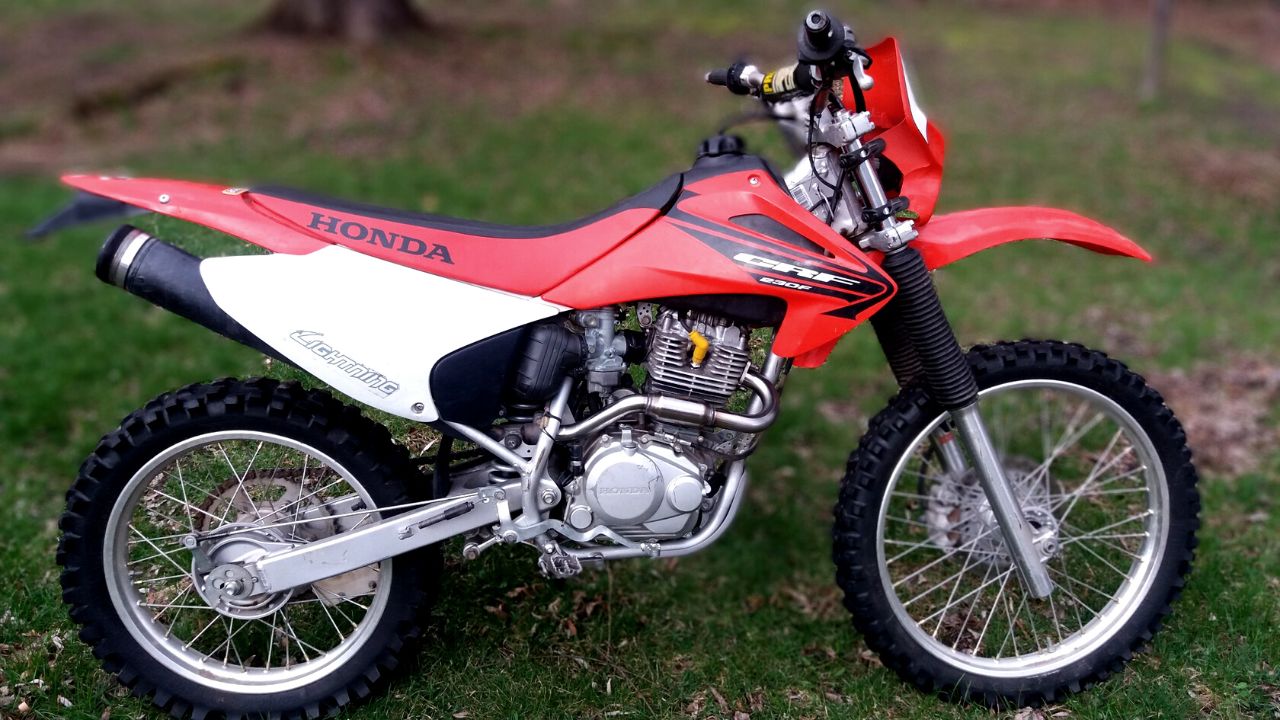
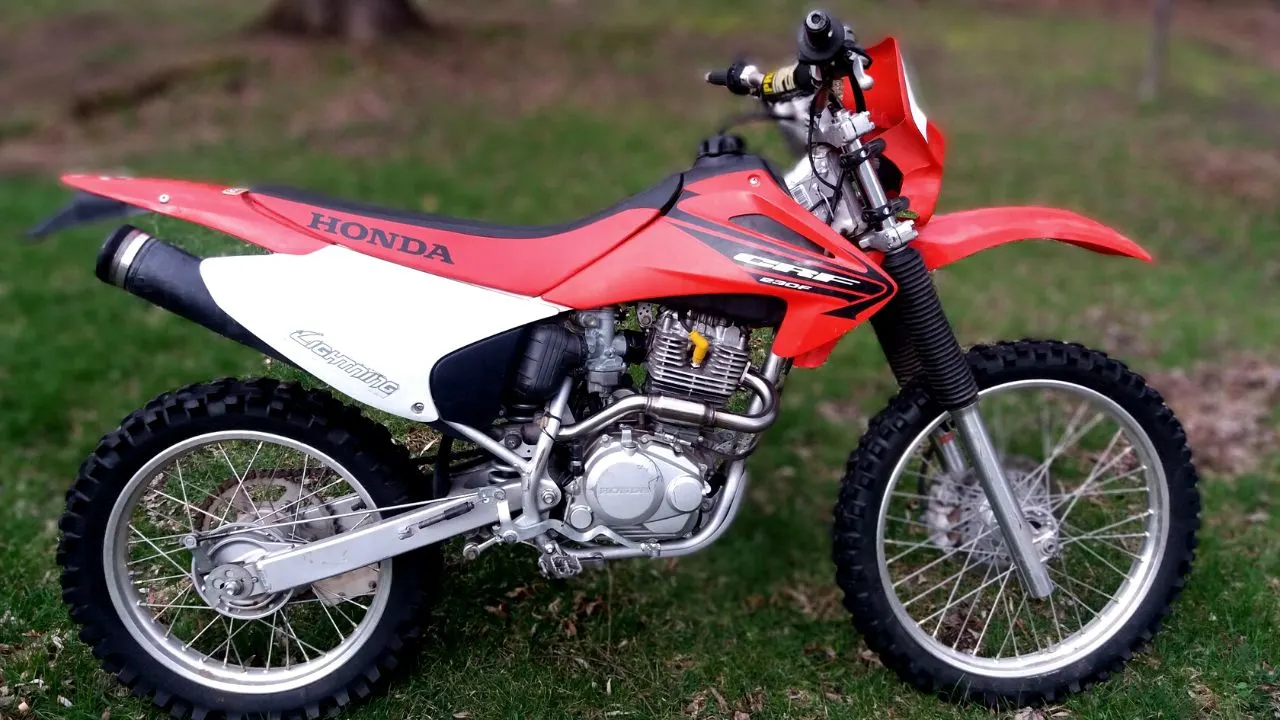
For a little more than 100 bucks I got them back and installed them myself. I was greatly impressed because the damping was much more progressive, and the pre-load was spot on for my weight.
For the best budget fork upgrade, a good tuner like Bruce is the way to go, especially if you’re intimidated by working on the suspension. He is extremely easy to talk to and will explain everything in detail. His speed and cost are beyond fair in my opinion.
CRF230F Fork Conversions - From different bikes?
There are numerous fork conversions that have been done to the CRF230F. Whichever kind of fork setup you want depends on how much work you're willing to do.
CR85 to CRF230 Fork Conversion
Probably the first and most popular fork swap was the CR80/CR85 forks, which is what I have on my 230. They are one of the lightest forks that can be fitted to this bike.
Adapter kits were being made by at least one manufacturer/person, but they can be difficult to source if you don't have the resources to make your own adapter parts.
The CR85 forks require a lower triple clamp relief mod for the steering stem to be long enough, wheel spacers, brake caliper adapters, fender mounting mods, and a longer brake line. There are probably a couple of other small things to make everything fit and work.
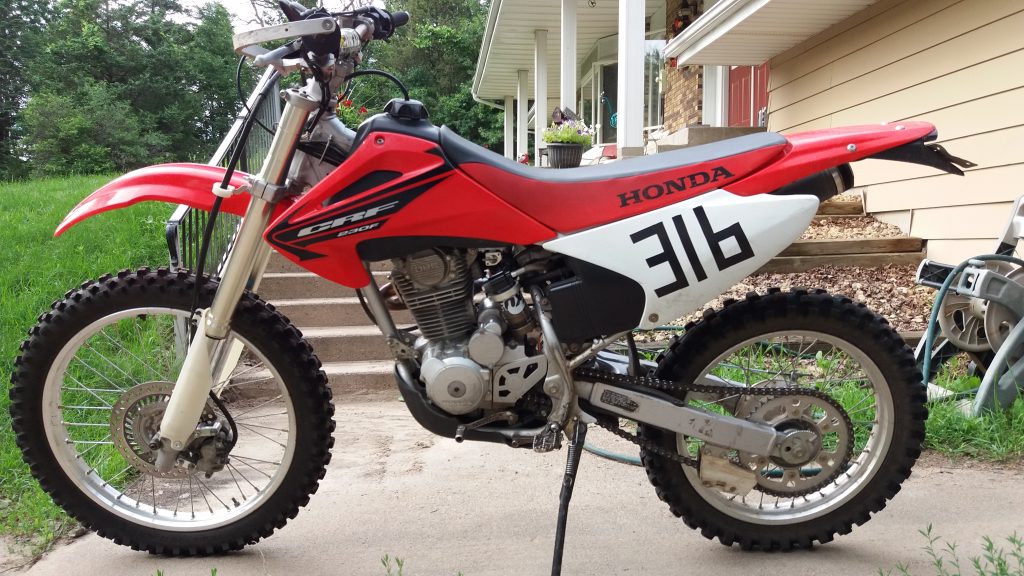
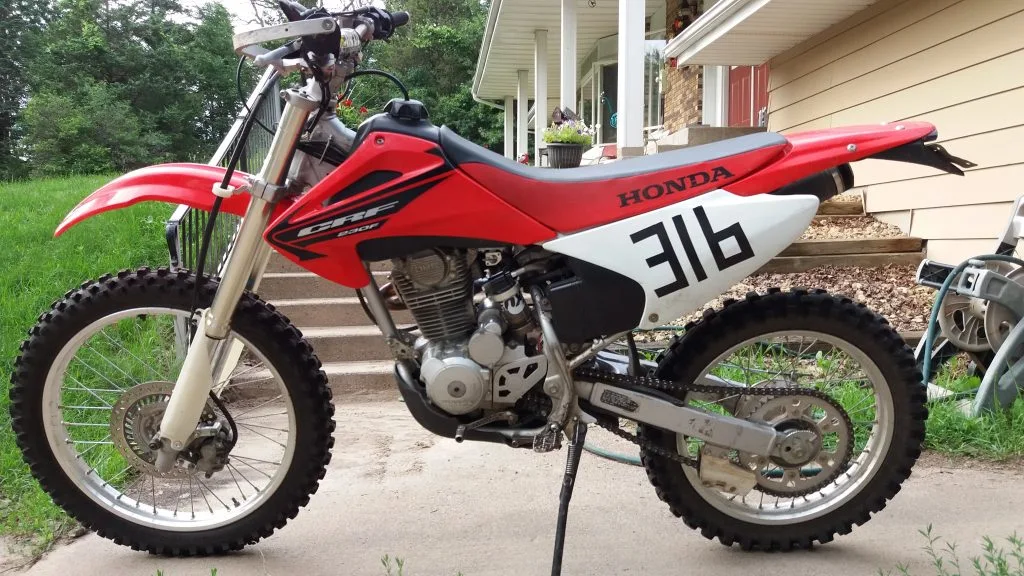
Then there's setting up the fork spring rate and valving. Stiffer springs are required, but the valving needs to be softer for trail riding, or else it will be a harsh ride. If properly set up, these forks are on another level compared to the stock 230F forks. Having extra travel helps too.
XR400 Fork Swap
The latest popular fork conversion is taking a complete XR400 front-end and bolting it onto the CRF230 chassis. There are still some small mods that need to be done, such as shortening the steering stem, but these are very capable forks, especially after some valving changes.
3 — Uncork the Intake & Exhaust - Then Rejet It
Once the bike runs properly and the suspension is adequate for you, uncorking the CRF230F is probably the best inexpensive performance modification.
Opening the restricted intake and exhaust allows the engine to breathe better, but there's an important catch: more airflow changes the air/fuel mixture.
That's why I treat uncorking and carb tuning as one modification—not two unrelated mods.
Next: Learn how to jet a 4-stroke dirt bike based on symptoms instead of blindly copying jet sizes →
How To Un-Cork Your CRF230F
A lot of trail bikes come corked or choked up from the factory. Usually for emission and sound limit reasons to meet EPA requirements. Changing the jets in the carb, as you just read, was part of the un-corking process.
The CRF230 has a baffle/restrictor on the intake and exhaust. These do help keep the sound output down, but they're limiting some potential power.
To un-cork a Honda CRF230F, simply remove the intake air box lid and exhaust baffle. Jetting must be changed if it's still stock from the factory.
Air Box
The CRF230 has an average-sized air box, but there's not much room for air to get in to reach the carb. The more air you can get through the carb, the more potential gas you can get through it as well, which will make more power.
This is theoretical, of course, because the engine has to be able to properly burn all of that air and fuel to make the power.
Why do we install bigger carbs on dirt bikes? They suck more air in to boost the horsepower (when properly tuned). However, other factors come into play, such as the velocity of the air. Air velocity is how fast the air is going through the intake, which plays a bigger role in low-end torque.
For example, when you go to a bigger carb the top-end power is increased, but some low-end torque is usually lost. Getting into the science of it is interesting, but that's not what this article is about.
Remove The Lid
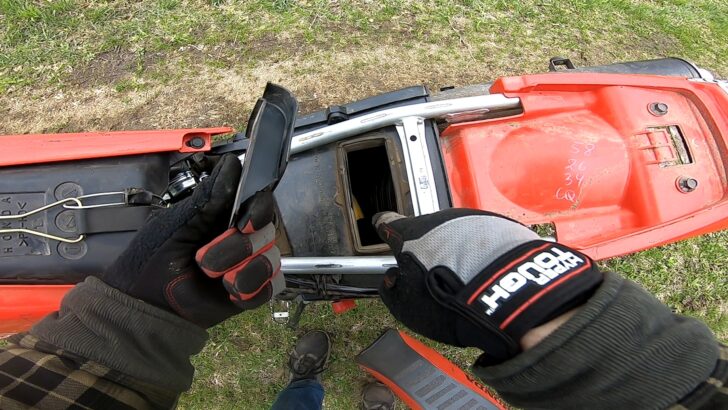
There is a lid on the top of the airbox that can be removed to make the opening bigger. You'll need to take the seat off to access it.
A little more dust will be able to get in, but it's generally worth it if you're looking for more power. This is why it's important to have a quality air filter that is regularly cleaned or changed.
Air Filter
Going to a quality aftermarket air filter will also allow more air through, giving you more power and better throttle response. Just remember to keep it clean, especially if you ride in sandy/dusty areas.
Muffler Baffle/End Cap
While the stock head pipe is the biggest restriction (more on this later), the factory muffler on the Honda 230 has a baffle with a built-in spark arrestor on it. This can be removed to gain some low-end torque and throttle response.
However, this will greatly increase the sound decibel output. I don't recommend this modification if you live in a suburban area with neighbors close by or if you ride at a trail/park that requires a USFS approved spark arrestor.
What About the Rest of the CRF230F Mods?
Once those basics are sorted, the rest depends on how far you want to take the bike. The following upgrades make more sense for specific needs or higher-performance builds.
Is a Bigger Carb Worth It?
For a mostly stock CRF230F, I wouldn't replace the carb just because it's stock. Get the stock carb properly jetted first.
Once you've opened up the intake/exhaust—or especially if you're adding engine mods—a better carb starts making more sense.
I've used a PWK28 carb setup because it can improve throttle response and airflow while still working well for trail riding. A properly set-up pumper carb is another option if you want especially crisp response.
Just remember: bolting on a bigger carb doesn't automatically make the bike run better. It still needs the correct adapters, setup and jetting.
Where the Stock Carb Is Limited
The stock carb works well for a mostly stock trail bike once it's properly jetted, but it does have limitations when you're looking for more throttle response and performance.
One is its response to a sudden throttle opening at low RPM. A properly set-up accelerator-pump carb can add fuel during that transition, which can provide crisper response when you quickly open the throttle.
XL250 OEM Carb
The old Honda XL250 carb is basically the easiest bolt-on performance carb upgrade for the CRF230. The problem is, they're hard to find, and they usually need a rebuild with replacement parts that are hard to find in stock.
The reason why the XL250 carb is better is primarily because of the accelerator pump. The AP is a mechanical pump that squirts a small shot of fuel through the carb at low RPM throttle openings. This extra fuel produces more low-end power and throttle response because it helps get rid of that lean spot.
Keihin PWK28 Carb Conversion
A genuine Keihin PWK 28 carb (Amazon) is well known to be a great carb upgrade for the CRF230F, even if your engine is stock. It's smaller, lighter, easy to tune, and it outperforms the stock carb in every way.
The biggest setback is the cost and time to adapt it to the CRF230 intake manifold. A new genuine PWK28 is over 200 bucks, but setup with the right jetting and it's ready to go with some adapters and a different throttle assembly. The stock carb has push and pull cables while the PWK just has one pull cable.
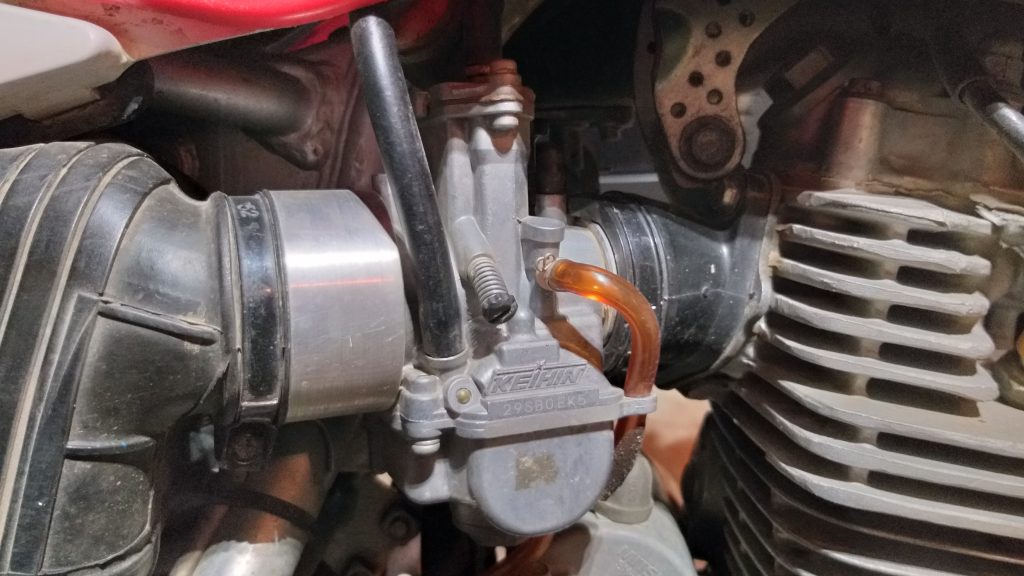
Adapters are needed because it's shorter than the stock carb and the inlet/outlet diameters are smaller. They can be machined and pressed on, or you can get creative with some tubing from a local hardware/tool supply store.
Chinese Copy Carbs - XL250 Pumper or PWK28
If you want to upgrade your carb but don't mind the risk of a lower quality Chinese copy carb, you can get the XL250 pumper carb or PWK28 carb on Amazon for much less than OEM prices.
Just keep in mind that you will likely have to tune/fiddle with them to get them to run right, and they may be harder to tune properly compared to a Genuine Keihin carburetor from Japan.
*Requires different carb mounts to fit stock CRF230F intake manifold and air boot
Do You Actually Need an Aftermarket Exhaust?
Not necessarily.
If your CRF230F is mostly stock and you're trail riding, I wouldn't make an expensive exhaust my first modification.
Start by getting the stock carb properly tuned and uncorking the intake/exhaust. That's considerably cheaper and lets you find out how much performance you actually need.
A complete aftermarket exhaust makes more sense once you're also increasing airflow through the carb/intake or adding engine modifications, because the engine can take better advantage of the additional flow.
The tradeoff is noise. For trail riding, I also want a legal spark arrestor where one is required.
Which CRF230F Exhaust Would I Choose?
Did you know that the CRF230F and CRF150F (03-05) share the same size head pipe? Honda wanted to save money, so they didn't develop a new head pipe that works better for the larger engine, so they used the pipe from the smaller engine.
This is a choke point, so going with a larger diameter header pipe will provide a noticeable power gain even if your engine is stock.
My Personal Review:
I have an FMF Powerbomb head pipe with the stock muffler and a custom end cap on my CRF230F. The FMF header has a reduced diameter where it meets the midpipe/stock muffler joint, so it still restricts flow even though it's larger than stock up until that point.
- Budget: uncork stock system + rejet or Amazon exhaust system
- Full system: Pro Circuit or Yoshimura (Motosport)
- What I actually used: FMF Powerbomb (Motosport) + stock muffler/custom end cap
- What I'd do now: complete system rather than piecing one together
Out of the above options, I would probably go with the Yoshimura or Pro Circuit (Motosport) exhaust system if I had to do it over again. That way I get the whole system without needing to do any mods later to open it up more.
CDI / Ignition Upgrade — Worth It?
I've used a ProCom CDI on my CRF230F, and unlike some "rev box" upgrades, I actually noticed an improvement in low-end and midrange torque.
The ProCom changes the ignition timing, which is more useful to me than simply raising the rev limit. It's also advertised as removing/increasing the stock rev limiter, but I've never tested how high it will actually rev because there's little reason to rev a CRF230F that high.
My original ProCom CDI lasted about 7 years before it failed. I paid around $35 for it at the time, which made it an easy performance upgrade. At roughly $89 now, it's harder to call it a bargain, but I'd still consider one after the basic jetting, suspension and airflow modifications are sorted out.
My take: I like the ProCom CDI for the improvement in low/midrange power—not because of the higher rev limit. Just understand that my original unit eventually failed, and make sure the CDI you're buying is compatible with your CRF230F.
High-Compression Piston / Big Bore
Once you've addressed suspension, intake, exhaust and carburetion, engine work is where the CRF230F can become a surprisingly capable sleeper trail bike.
A larger-displacement or higher-compression piston is especially useful on this bike because the biggest benefit for trail riding is increased torque, not simply chasing a peak horsepower number.
But the supporting mods matter. A bigger engine and/or higher compression can benefit much more from a properly sized carb, opened intake and freer-flowing exhaust than a completely stock engine can.
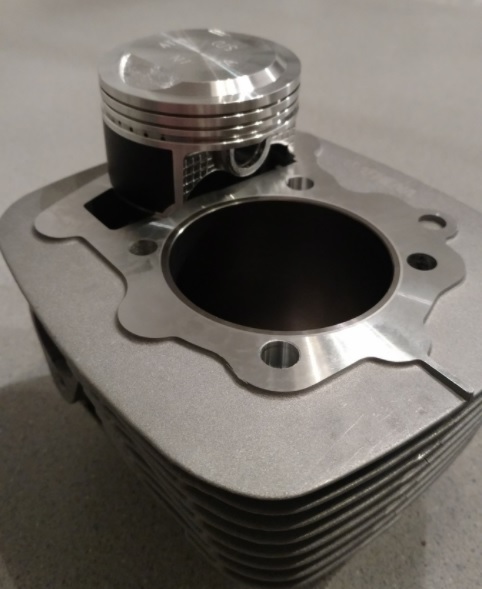
Interested in higher compression or a big-bore kit on your own CRF230F?
Read my CRF230F Piston Kit review and results →
Read my CRF230F big-bore review and results →
*If you're running higher compression, you'll need to run 91 premium pump gas (race gas isn't needed on these aftermarket kits)
Camshaft & Head Work
If you're already doing a high-compression or big-bore build, a camshaft (Web Cam Racing) and properly ported head are the next step toward getting more power out of the larger engine.
This is where I'd stop thinking in terms of individual bolt-on parts and start treating the engine as a complete system: displacement/compression, cam timing, cylinder-head flow, carburetor, intake, exhaust and jetting all need to work together.
For a normal trail rider, I wouldn't go this far. For a sleeper CRF230F build, however, this is where the bike can become surprisingly fast.
Which camshaft is best for your CRF230?
The camshaft is one of the biggest pieces to the puzzle of any 4 stroke engine. It determines where the power is made and how it comes on. Web Cam Racing is the biggest producer of camshafts for the CRF230F.
If you want more low-end torque, go for higher lift and low to moderate duration. The more duration you add the higher in the RPM range the power shifts towards.

Head Porting - Bigger Isn't Always Better
The other secret sauce to building a great engine is in the ports. Cylinder head porting can make or break an engine's power-band, and it's easy to do the latter if you don't know what you're doing. Just making the ports larger probably won't help as much as you think. In fact, it may make it worse and kill your bottom-end power.
The weakest link in the CRF230F cylinder head is the intake port. It is restrictive, and unfortunately, there isn't much room to work with before breaking through the port wall.
Finding a porting specialist that knows the 230 engine specifically is key to getting the most efficient power gains.
Making Everything Work Together
A stock CRF230 head can only flow so much air. Even if you add a big bore, a larger carb, and a better-flowing exhaust, the intake port is going to choke up the potential that you could be getting.
Everything in the engine works together, so if you're going for a specific type of power-curve, all the components should be tuned for that RPM range.
Advanced CRF230F Engine Mods
These aren't modifications I'd recommend for the average CRF230F owner, but they're a few of the more advanced modifications you can make if you're trying to get everything possible out of the engine.
Flywheel Key - More Torque & Throttle Response
Similar to the ProCom CDI mentioned earlier, a modified flywheel key can advance the timing to boost low-end power and throttle response. The flywheel key indexes the flywheel, which is on the crankshaft. Removing material from one side of the key will change the timing of the flywheel.
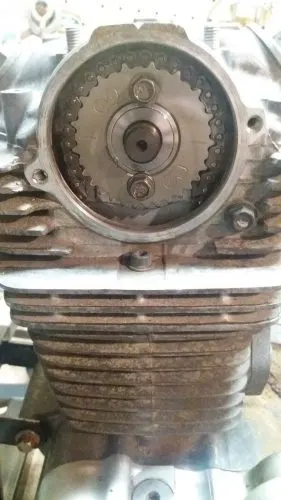
Adjustable Camshaft Sprocket
Want even more timing adjustability? Slot the cam sprocket holes to "degree in" your camshaft, especially if it's an aftermarket race cam. It's always good to check the cam timing and valve clearances when installing a new camshaft.
Most of the time the cam builder will get the timing spot on, but occasionally you may need to adjust it a couple degrees to get it where you want it.
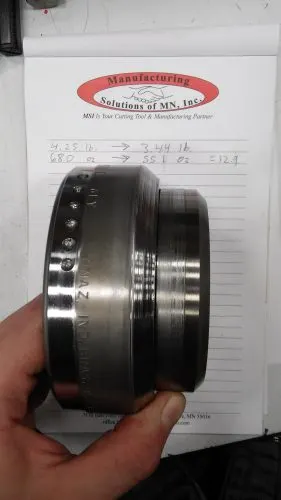
Lightened Flywheel - Snappier Power
Not only will the engine be lighter, but it will rev quicker for better acceleration. Removing 12+ ounces from the circumference of the CRF230F flywheel is easy with a machinist lathe. The engine and flywheel are already so heavy that removing up to 1 pound will not make it easy to stall due to the lighter rotating mass.

Bonus Mods - Gearing
Gearing doesn't add horsepower—it changes where and how easily you can use the power you already have.
Lower gearing can make technical riding and clutch work easier, while taller gearing can reduce RPM and shifting at higher trail speeds.
I wouldn't change gearing just because someone online says a particular sprocket combination is "better." Choose it based on where you actually ride.
Tires - Bolt-on Traction & Comfort
Do you have the original tires on your CRF230? Even if they still have plenty of tread left, going to a different tire for the appropriate terrain will be an upgrade.
If your current tires don't suit your terrain, the right tires can make a bigger difference in traction and confidence than adding more engine power. I really like the Shinko 524 (Amazon) on the front and an IRC VE33 (Amazon) on the rear. They both work well in every terrain I've ridden my 230F.
Make the CRF230F Fit You Better
Before chasing horsepower, make sure you can comfortably control the bike.
Wider footpegs, the right handlebar bend, and properly positioned controls can make a surprisingly large difference—especially for a taller adult on the relatively compact CRF230F.
Don't automatically install extremely tall bars or huge risers just because you're tall. Bar position changes your riding position and leverage, so the goal is proper body position, not simply making the bike feel taller.
If the bike feels cramped or awkward while standing, don't assume the handlebars are the problem.
→ See how to properly stand on a dirt bike before changing your controls
Can you lower the seat height?
Yes, there are a few ways to lower your CRF230F seat height, but they all affect the handling or ergonomics. For example, a lowering link (Amazon) is a simple and easy way to make your 230 close to 2" inches lower in the rear, which is great if you or your wife has short legs but still wants a full-size dirt bike.
To keep the front suspension balanced with the lowered rear, you'll want to lower the forks as well, either with a spacer or dropping the triple clamp height. A lowering link will make the steering slower, but if you're a beginner you probably won't notice much of a difference.
It's a nice mod that's easy to put back to the original setting when you're ready for a higher ground clearance or want to sell your bike.
CRF230F Mods I Wouldn't Do First
After modifying and riding CRF230Fs extensively, there are a few upgrades I wouldn't spend money on first:
Aftermarket exhaust: Not before getting the stock carb and basic uncorking sorted out.
Big-bore kit: Great later, but wasted money if the suspension is constantly bottoming or the stock engine isn't even running correctly.
CDI/rev box: Useful for certain performance builds, but much lower priority than jetting, suspension and airflow.
Huge carburetor: Bigger isn't automatically better. Carb size needs to match the engine and how you want it to make power.
Cosmetic parts: Nothing wrong with them, but they won't make the bike easier to ride or perform better.
How I'd Build a CRF230F
Stock Beginner/Trail Bike:
- Properly tune the stock carb
- Set up suspension if needed for rider weight
- Uncork intake/exhaust
- Rejet after airflow changes
- Tires/controls/protection as needed
160–220 lb Adult Trail Rider:
- Properly tune the stock carb
- Springs + suspension setup
- Uncork intake/exhaust
- Rejet
- Ergonomics/tires/protection
- Consider carb/exhaust upgrade if you still want more performance
Sleeper CRF230F:
- Properly set up suspension — modified stock forks or fork conversion + quality rear shock
- Open intake + performance exhaust
- PWK28/pumper-style carb + proper jetting
- ProCom CDI / ignition upgrade
- High-compression or big-bore piston
- Cam/head work if you want to take the build further
What Should You Upgrade Next?
The best CRF230F mod depends on what's actually limiting the bike right now.
If it doesn't start, idle or respond correctly, fix the carburetor first.
If you're bottoming the suspension, fix the suspension before adding horsepower.
If it already runs and handles well but you want more power, uncork the intake/exhaust and retune the carb.
And if you've already done those things and still want more, that's when a better carb, exhaust and engine work start making sense.
Don't modify the bike just because there's a part available for it. Fix the thing that's actually holding you—or the bike—back.
Is your CRF230F bogging, hard to start or not running cleanly?
→ Get my free 4-stroke fuel screw tuning guide
Want more power from your CRF230F?
→ See what happened when I installed a big-bore kit on my CRF230F

Tom Bolton
Sunday 16th of May 2021
I took an honest 16.2 pounds off my 2004 CRF230F and some other mods, what a difference!
This is my video: https://youtu.be/o5ovHodBLck
Kelley Fager
Sunday 16th of May 2021
Nice! They're fun bikes. Thanks for reading, Tom!
ben
Sunday 9th of May 2021
umm how much does it cost to replace the forks
Kelley Fager
Monday 10th of May 2021
Hey Ben, thanks for reading! It depends on which fork option you go with and how much work you do yourself. CR85 or XR400 forks can be found for around 400-500, but there's some parts and spacers that require machining, which can cost another 500+. A basic re-valve on the stock forks, which is the best budget option, is just over 100 bucks.
Ian Blyde
Wednesday 27th of January 2021
Hi all, - CRF230 off set crank pin, does anyone know where i can get/order a off set crank pin for my crf230, there's heaps of info about them out there but nothing about where you can buy one, if anyone can help please email their contracts to jennyandian@orcon.net.nz thanks for your help, Ian
Yannick Bolduc
Monday 26th of October 2020
Hi great blog !! been here and read it a lot since i have modified and have fun at doing so on my 230f :) i have a question regarding the carb swap for the PWK . When you change the carb do you have to change the cable wire ? or you can keep the pulling cable and it will connect in the PWK carb ? I just received my athena big bore kit and i think i will be better with a bigger carb or putting a #135 jet in the stock carb . Thank you very much for the creation of this blog and thx :)
Kelley Fager
Tuesday 27th of October 2020
Hey Yannick, thanks for the comment! I believe I changed to a CR85 throttle cable for the single pull. I would have to dig through my notes to check actual part numbers though. You will definitely like the bigger carb with the big bore once the jetting is properly set!
Thanks Kelley
Monday 3rd of August 2020
Great post. currently have a crf230f motor into a 1985 Honda 200x. Bolts right in other than the cylinder motor mounts.
I have frame clearance issues if i run the stock carb or a pd pumper and the pwk specs your running in the post was very helpful. Going to give one a try.
The old cr85's also use factory pwk 28's.
Much appreciated.
Kelley Fager
Tuesday 4th of August 2020
Ah, yes I've heard of some people swapping them into those things. Yeah, the stock carb is pretty large and cumbersome. What are you using for intake adapters? Yes, the later CR85 does have the PWK, but I believe it has a different slide as well as jets (a given). The slides are pretty expensive, which is why I ordered a new PWK and also had the idle screw installed on the right side for easy access on my 230.