Comparing the Yamaha TTR125 vs Honda CRF125F? Both are beginner-friendly 125cc four-stroke trail bikes, but there are some important differences that could make one a better choice for you.
My recommendation: I'd choose the CRF125F if you're buying a newer bike and want fuel injection, or the TTR125 if you're looking for an affordable used trail bike.
I've owned multiple TTR125s and CRF125Fs and spent years riding and working on beginner dirt bikes. Here's how these two bikes compare in size, power, reliability, and cost—so you can choose the one that fits your needs and budget.
TTR125 vs CRF125F: What's the Biggest Difference?
Both bikes are air-cooled, four-stroke trail bikes with manual clutches. Neither is designed for motocross racing, but both can be great for learning to ride and exploring easier trails.
| Feature | Yamaha TTR125 | Honda CRF125F |
|---|---|---|
| Fuel system | Carburetor | Fuel injection on 2019+ models |
| Transmission | 5-speed | 4-speed |
| Wheel-size options | Large-wheel current model; smaller-wheel older models | Small-wheel and Big Wheel |
| Electric start | Depends on version and year | Electric start |
| Seat height | 31.7" on TTR125LE | 29.1" standard; 30.9" Big Wheel |
| Used-bike availability | Many older examples | Fewer older model years |
| Best reason to choose it | Affordable used bike, simple carburetor | EFI on newer models, more size choices |
My pick: For a newer beginner bike, I'd lean toward the CRF125F. If I were shopping used on a tighter budget, I'd look seriously at a well-maintained TTR125.


My Experience Owning and Riding Both Bikes
I've owned multiple Yamaha TTR125s as well as two Honda CRF125Fs—a 2020 and a 2021, both with fuel injection. I've also taught many new riders how to use the clutch on both bikes.
While they're both excellent beginner trail bikes, there are a few differences that stand out after actually riding and working on them.
The CRF125F has noticeably better power and throttle response. It's not a massive difference, but the Honda feels a little stronger, and its fuel injection has been virtually flawless for me. Both of mine started easily, ran smoothly, and didn't have the carburetor issues I've dealt with on TTR125s.
The TTR125 is easier to crawl along at very low speeds. Its lower first gear means you can ride slower without slipping the clutch as much. That's especially helpful for someone learning how to get moving from a stop.
The Honda's four-speed transmission isn't my favorite, either. The first three gears feel noticeably clunkier than the Yamaha's five-speed transmission.
I've used both bikes to teach beginners, and both work well. I wouldn't hesitate to recommend either one, but these are the differences I'd consider before buying.
What Size Rider Fits a TTR125 or CRF125F?
These 125cc 4 stroke trail bikes are great for beginners, and the age range can greatly vary. You or your kid's height is the most important factor for minimum age.
Depending on which model Honda or Yamaha 125, they're made for the ages 9-16. With that said, they're great for women and young adults if you're learning how to ride a dirt bike.


Small Wheel vs Big Wheel: Which Should You Buy?
The small wheel 125 has 17/14” wheels, while the large wheel 125 has 19/16” wheels. Not only does the large wheel raise the seat height by about 1.5” for a taller rider, but it’s more stable.
The larger wheels make it easier to ride over bumps and logs, so I recommend the large wheel unless you or your kid is too short to safely ride it.
The Yamaha TTR125L large wheel model also has a disc front brake - the small wheel TTR125 has a drum front brake. It’s not a huge difference, but it’s noticeable, especially when it’s wet or muddy.
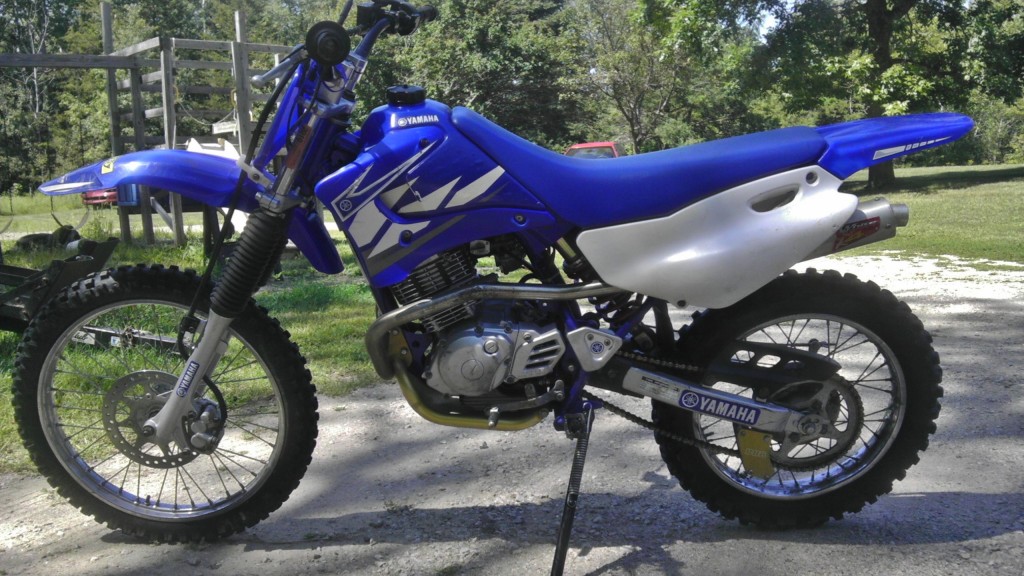

It's important to note that Yamaha only sells the TTR125LE model (large wheel), while Honda offers both the small wheel and big wheel models. If you want a small wheel TTR125/E, Yamaha discontinued them by around the year 2011.
TTR125 vs CRF125F Seat Height Comparison
The height of a dirt bike seat can be the deciding factor if you're worried about falling over because you can't touch the ground. Honda offers a big wheel and small wheel CRF125 with different seat heights, while Yamaha only has a large wheel TTR125 if you're buying new - although they had a small wheel option from 2000-2011.
Here are the seat heights of each 125cc dirt bike model:
- CRF125F (Small wheel): 29.1" (74cm)
- CRF125FB (Big wheel): 30.9" (78.5cm)
- TTR125/E (Small wheel): 30.5" (77.5cm)
- TTR125L/LE (Big wheel): 31.7" (80.5cm)
Not Sure Which Dirt Bike Fits Your Height?
The TTR125 and CRF125F come in different sizes, and even a small difference in seat height can affect how comfortable you feel when stopping or learning to balance.
Get my FREE Dirt Bike Size Chart to help narrow down which dirt bikes fit your height and riding experience before you buy.
Get the Free Dirt Bike Size Chart →
TTR125 vs CRF125F Engine: Which Is Easier to Ride?
Both bikes have mellow, air-cooled four-stroke engines designed to be manageable for newer riders.
The TTR125 has a carburetor and a five-speed transmission. I've owned and tuned several TTR125s, and when the carburetor is working properly, the engine has smooth, predictable power that's easy to learn on.
The CRF125F also has beginner-friendly power, but 2019 and newer models use fuel injection instead of a carburetor. That's one reason I'd consider a newer CRF125F if I wanted a bike that doesn't require carburetor tuning.
Neither bike is going to feel especially powerful to an experienced rider, but that's part of what makes them good beginner trail bikes.
My recommendation: I wouldn't choose between these bikes based on small horsepower differences. Fit, condition, fuel system, and price are more important for most beginners.


Engine differences
I've owned both the Yamaha TTR125 and the fuel-injected Honda CRF125F, and the Honda has noticeably more power. It's not a night-and-day difference, but it's enough that I could feel it while riding.
One thing I really like about the 2019-and-newer CRF125F is its fuel injection. Both of mine started almost immediately, had smooth throttle response, and didn't suffer from the bogging or inconsistent running I've experienced with some stock TTR125 carburetors.
That doesn't mean every TTR125 runs poorly. A properly tuned TTR125 can run very well, but the stock carburetor has some drawbacks that I've discussed in my TTR125 VM24 carb upgrade article.
If Yamaha gave the TTR125 a good EFI system, I think it could be just as good as—or possibly better than—the CRF125F.


TTR125 5-Speed vs CRF125F 4-Speed: Does It Matter?
The TTR125 has a five-speed transmission, while the CRF125F has a four-speed.
After owning both bikes, I actually prefer the Yamaha's transmission. The Honda's first three gears feel a little clunky to me, and its first gear is taller than the TTR125's.
Why does that matter?
The TTR125 can crawl along at a slower speed in first gear without needing as much clutch slipping. That also makes it a little easier for first-time riders to learn how to get moving from a stop.
I've taught many beginners clutch control on both bikes, and they're both good for learning. The difference isn't huge, but the Yamaha has a slight advantage here.
If you plan to ride lots of tight, slow trails, that's worth considering.
Reliability and maintenance comparison
Both the TTR125 and CRF125F are generally reliable trail bikes when properly maintained.
However, after owning two fuel-injected CRF125Fs, I strongly prefer Honda's EFI system over the stock TTR125 carburetor.
Both Hondas started reliably and ran smoothly without needing jet changes or carburetor adjustments. Fuel injection also avoids the small carburetor passages that can become clogged when gasoline sits too long.
The Yamaha's carburetor is simple to work on, and replacement jets and parts are readily available, but it may need cleaning or tuning to run its best.
One feature I appreciate on both bikes is the backup kickstarter. If the battery gets weak, having another way to start the bike is useful.
My pick for the least hassle with starting and fueling: the 2019-and-newer CRF125F.
I haven't owned or ridden the older carbureted CRF125F, so this recommendation is based specifically on my experience with the 2020 and 2021 EFI models.
Which Bike Handles Better on Trails?
With a slightly longer wheelbase and taller seat height, the TTR125LE will be slightly more stable than the CRF125FB when it comes to riding over obstacles and at higher speeds. You won't really notice the difference if you're a beginner, so it's not something to worry about if this will be your first dirt bike.
TTR125 vs CRF125F Weight Comparison
There's not much to compare when it comes to the wet weights. The big wheel Honda & Yamaha 125 are within 1 pound of each other at 198 and 199 lbs, with the TTR having the slight edge.
The curb/wet weight means that the dirt bike has all the fluids needed to ride, such as oil and fuel. The biggest difference here is the fuel capacity, which is covered below.
Which Bike Has Better Fuel Range?
Although it's not normally talked about, the amount of gas you can hold can be a big factor when choosing the right dirt bike - especially when one bike holds 60% more fuel!
That's right, the Honda CRF125 has a 1.0-gallon fuel tank capacity, while the Yamaha TTR125 holds 1.6 gallons! This means you can ride close to 50% further without having to re-fill.
That may not matter if you're just riding around your house and yard, but if you're out on the trails all day, that means you won't need an oversize tank or have to haul extra fuel.
TTR125 vs CRF125F: New and Used Prices
When comparing new prices, the TTR125LE is slightly cheaper than the same size CRF125FB (big wheel) and is the same base price as the CRF125F (small wheel). This is likely due to the added features on the Honda, such as fuel injection and the recently updated chassis.
Here are the new MSRP prices of each model:
- Honda CRF125F: $3,599
- Honda CRF125FB: $3,999
- Yamaha TTR125LE: $3,599
What about used prices?
Maybe you can't afford to buy a new dirt bike and need to buy a used bike that's reliable. In that case, the TTR125 is almost always going to be cheaper because it's been around much longer and therefore a much bigger supply.
For example, you might be able to find a used CRF125F for around 2500 bucks, while you can find an older TTR125 for 1000-2000 dollars, depending on the year and condition.
Yamaha TTR125 Pros and Cons
Do you like blue? Okay, that’s not the only thing it has going for it…


Here are some pros and cons to the Yamaha TTR125:
Pros:
- Cheap to find used
- Used parts are cheap and easy to find
- Aftermarket is pretty good
- The bike hasn’t changed much since it started in 2000
- 4 different models to choose from
- 5 speed transmission
Cons:
- Some parts don’t feel as quality/durable as other bikes in its class
- Stock carb is finicky (gets dirty quickly and choke is poor quality)
- No fuel injection
Honda CRF125F Pros and Cons
There are quite a few reasons why you should choose the Honda 125 over the Yamaha 125, but it does have some setbacks.


Here are the highs and the lows of the Honda CRF125F:
Pros:
- All models have an electric start
- 2019 & newer have fuel injection
- It's a Honda - durable & reliable
- Low fuel indicator
- Keyed ignition (more theft resistant)
Cons:
- Costs more due to newer/technology
- EFI tuning isn't quite as simple as swapping jets without a good tuner
- Only has a 4 speed transmission
In the end, the Yamaha 125 vs Honda 125 battle will never end, but based on your needs, you should be able to decide on which one will be best for you now.
Which Should You Buy: TTR125 or CRF125F?
After comparing both bikes, here's how I'd decide.
| If you want... | I'd lean toward... |
|---|---|
| An affordable used beginner dirt bike | TTR125 |
| A newer bike with fuel injection | CRF125F (2019+) |
| A lower seat height | CRF125F standard |
| A larger fuel tank for longer trail rides | TTR125 |
| A simple carbureted bike you can tune yourself | TTR125 |
| A beginner bike for a shorter rider | CRF125F standard, depending on fit |
| A larger-wheel beginner trail bike | Either TTR125LE or CRF125F Big Wheel |
The most important thing is finding a bike that fits you and is in good condition.
I'd rather buy a well-maintained TTR125 than a neglected CRF125F, or vice versa. Especially when buying used, the condition of the engine, suspension, brakes, and other components matters more than the brand.
TTR125 vs CRF125F: My Final Recommendation
After owning both bikes and teaching beginners on them, I'd choose the 2019+ CRF125F for most newer riders because of its reliable fuel injection, slightly stronger power, and smooth throttle response.
However, the TTR125 is still an excellent choice, especially if you're buying used or want a lower first gear that's easier for slow-speed riding and learning clutch control.
You really can't go wrong with either one as long as it fits you and is in good condition.
Still Not Sure Which Bike to Buy?
Here's what I'd recommend doing next:
Leaning toward the Yamaha? Read my TTR125 review to learn more about its strengths, weaknesses, and what it's like to own.
Considering the Honda? Read my CRF125F review to see what I like and dislike after owning two of them.
Not convinced either bike is right for you? Check out my Best Beginner Dirt Bikes guide to compare other options.
Still unsure which size bike fits you? Grab my FREE Dirt Bike Size Chart before buying.