
Learn how to properly adjust your 2-stroke air screw for easier starting, smoother idle, and crisp throttle response - plus how to know when adjusting the air screw isn't enough.
If your 2-stroke dirt bike is hard to start, has a bog or sputter right off idle, or just doesn't respond crisply when you crack the throttle, the air screw is one of the first adjustments you should check. It's quick to adjust, doesn't require taking the carburetor apart, and can make a noticeable difference in how your bike starts, idles, and runs.
The problem is that many riders aren't sure which way to turn the air screw or how to know when they've actually found the correct setting. In this guide, I'll show you the exact process I use, explain what the engine is telling you, and help you determine when a simple air screw adjustment is all you need - and when the problem is actually the pilot jet or something else.
Free 2-Stroke Air Screw Guide
Perfect for the garage or the trail.
Print it, save it on your phone, or keep it in your toolbox. This free guide walks you through the exact air screw adjustment process, explains what symptoms to listen for, and helps you know when it's time to change the pilot jet instead.
How to Adjust a 2-Stroke Air Screw (Quick Answer)
If your 2-stroke dirt bike is hard to start, has a bog or sputter just off idle, or doesn't have crisp throttle response, adjusting the air screw is often the quickest place to start. The air screw controls the air/fuel mixture from idle to about ¼ throttle, making it one of the most important adjustments for easy starting, a smooth idle, and clean low-speed power.
Always adjust the air screw with the engine fully warmed up. Start by making small adjustments—about ¼ to ½ turn at a time—then listen to the engine and take a short test ride.
- If the bike has a lean bog or hanging idle, turn the air screw in (clockwise) to richen the mixture.
- If the bike sputters, loads up, or feels rich off idle, turn the air screw out (counterclockwise) to lean the mixture.
The goal isn't simply to find the highest idle RPM. You're looking for the setting that gives you easy starting, a steady idle, and crisp throttle response when you quickly open the throttle from low RPM.
If the bike still doesn't run correctly after adjusting the air screw, don't keep guessing. That's usually a sign that the pilot jet size is incorrect or another problem is causing the symptom, and the air screw alone won't fix it.
Looking for something specific? Jump to the section you need below:
Jump to:
Prefer to watch instead? Here's a quick walkthrough of the entire adjustment process:
How to Adjust a 2-Stroke Air Screw (Step-by-Step)
Adjusting the air screw only takes a few minutes, but doing it the right way can make a noticeable difference in how easily your bike starts, how smoothly it idles, and how crisp the throttle feels right off idle. I always recommend making one adjustment at a time and paying attention to how the bike responds before making another change.
1. Warm the Engine Completely
Before touching the air screw, ride your bike for 5-10 minutes until it's fully warmed up. This is one of the most common mistakes I see.
As the engine warms up, the air/fuel mixture changes. If you adjust the air screw on a cold engine, it will usually need to be adjusted again once the bike reaches normal operating temperature.
If your bike has been sitting in the garage idling for several minutes, that's usually not enough. Take it for a short ride so the engine, transmission, and coolant (if liquid-cooled) all reach normal operating temperature.
2. Locate the Air Screw
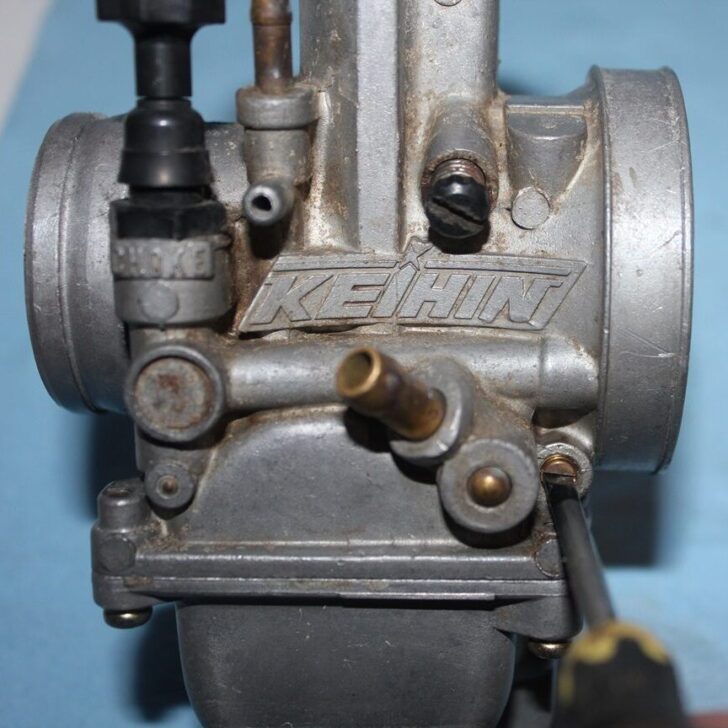
The air screw is the small brass flat-head screw on the side of the carburetor near the engine side of the intake.
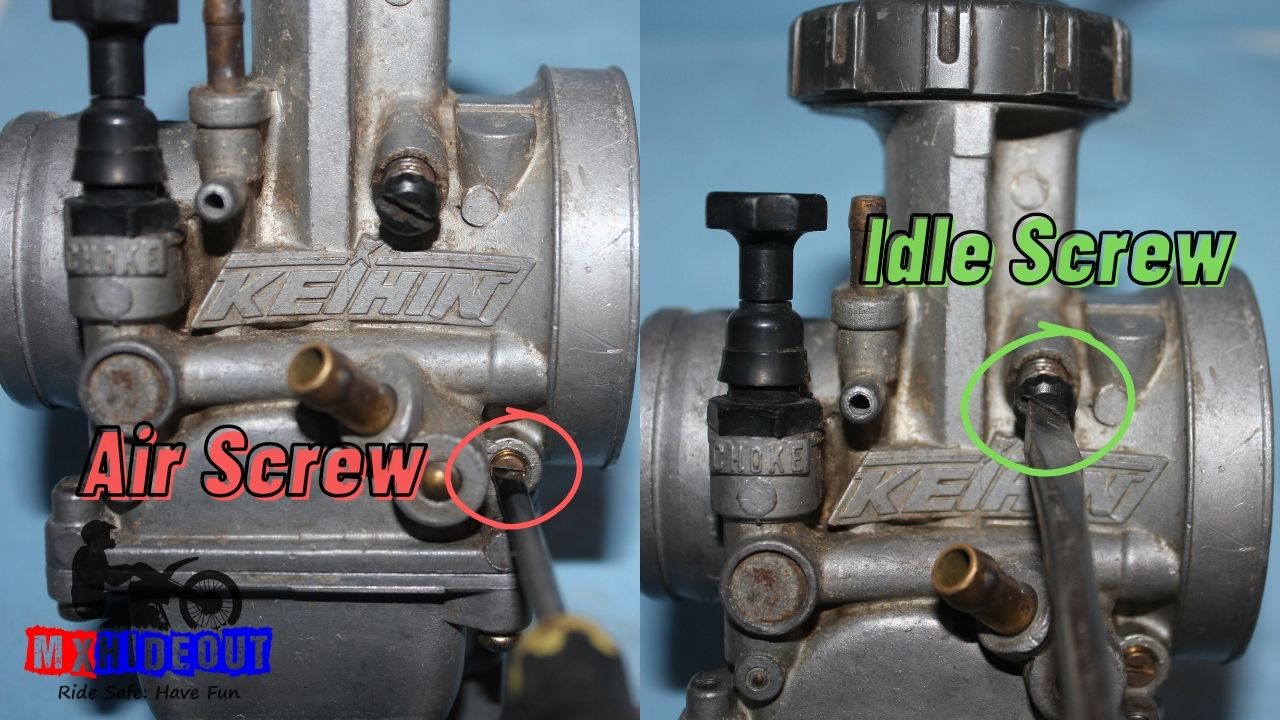
Don't confuse it with the idle speed screw.
- Air screw: Adjusts the air/fuel mixture from idle to about ¼ throttle.
- Idle screw: Raises or lowers the idle RPM only.
If you're unsure which screw is which, check your owner's manual or carburetor diagram before making adjustments.
Tip: Before making any changes, lightly turn the air screw clockwise until it just seats while counting the number of turns. Then return it to its original position. This gives you a reference point in case you want to go back to your previous setting.
If you don't see the air screw on the side of the carb, it may have a fuel screw (article) - it functions opposite of the air screw when turning it, which is commonly found on the bottom front of the carburetor on 4-stroke dirt bikes.
3. Make Small Adjustments
Start by turning the air screw ¼ to ½ turn at a time.
There's no reason to spin it several turns all at once. Small adjustments make it much easier to feel what the engine is telling you.
If you're trying to fix a lean bog or hanging idle, turn the air screw in (clockwise) to richen the mixture.
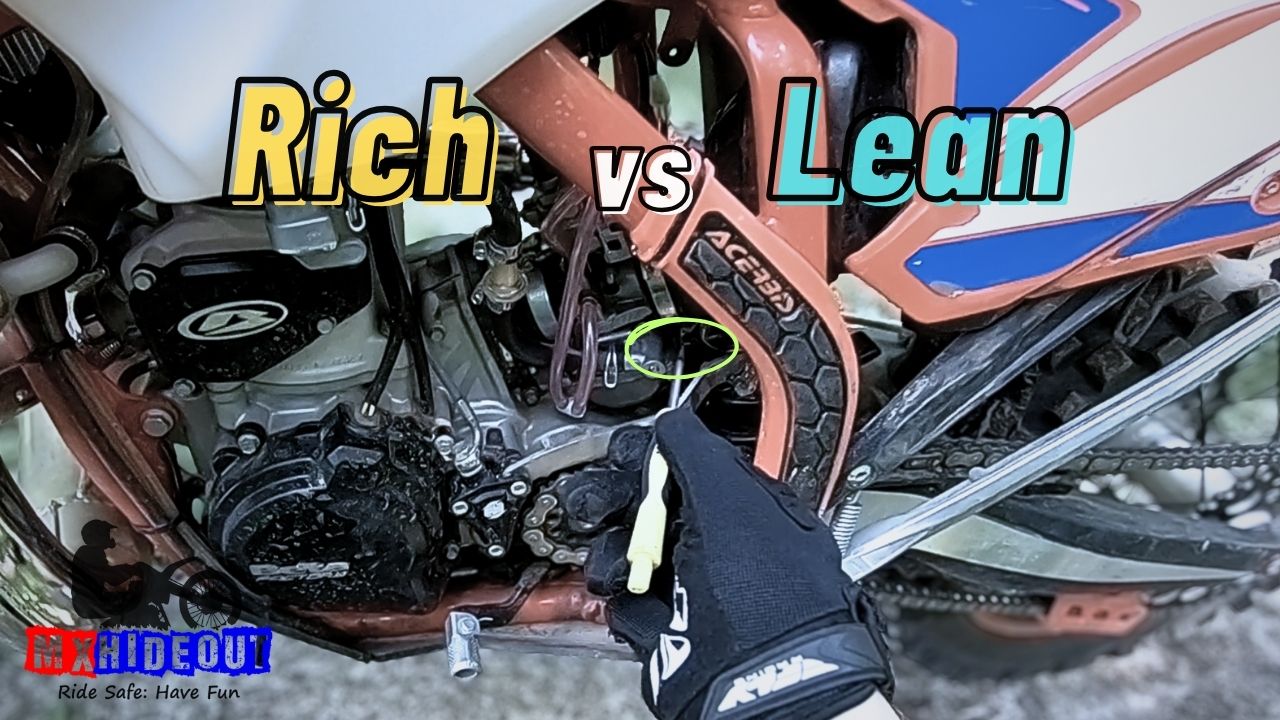
If your bike sputters, loads up, or feels rich just off idle, turn the air screw out (counterclockwise) to lean the mixture.
After each adjustment, let the engine idle for a few seconds before checking the throttle response.
4. Listen to the Engine
Don't focus only on the idle RPM.
A lot of tuning guides tell you to simply find the highest idle speed, but that's only part of the process.
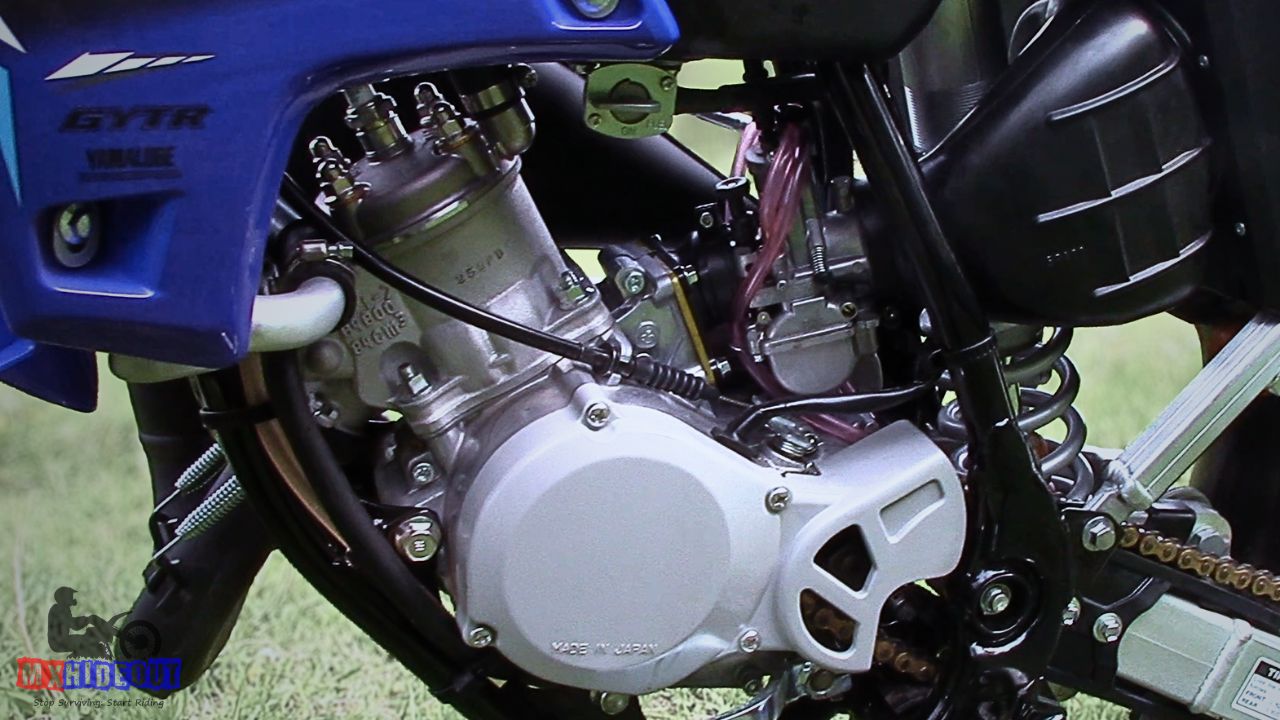
Instead, listen and feel for three things:
- Does the bike start easily?
- Does it have a steady, smooth idle without loading up or hanging?
- Does it have crisp throttle response when you quickly open the throttle from a low RPM?
That's the combination you're looking for.
If the idle becomes erratic, the engine hesitates, or the throttle response gets worse, you've probably gone too far in one direction.
5. Test Ride the Bike
Once the engine sounds good, take it for a short ride.
I like to ride at a low RPM and quickly open the throttle. This is where you'll notice the biggest difference.
If the throttle responds cleanly without hesitating or sputtering, you're moving in the right direction.
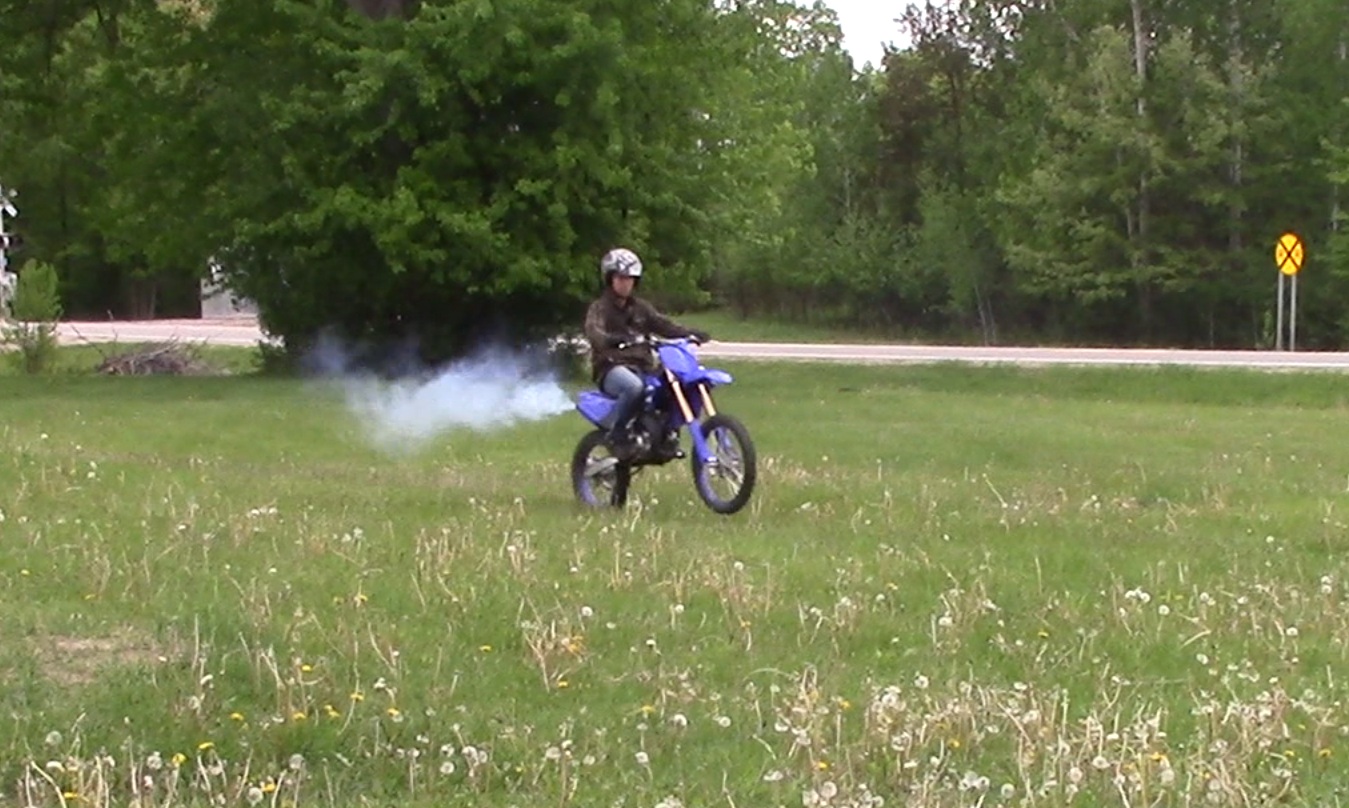
If the symptom is still there, stop and make another ¼ to ½ turn adjustment, then test ride it again.
Repeat this process until the symptom is gone or you've reached the limits of the air screw's adjustment.
6. Adjust the Idle Speed if Needed
Changing the air screw often changes the idle speed.
If you richen the mixture, the idle RPM will usually decrease.
If you lean the mixture, the idle RPM will often increase.
After you've found the best air screw setting, use the idle speed screw to bring the idle back to your preferred RPM.
This is completely normal and doesn't mean you've done anything wrong.
7. If You Can't Tell a Difference
Sometimes the symptom changes very little, even after several adjustments.
When that happens, I like to compare the two extremes.
Lightly seat the air screw clockwise until it stops—don't force it—and then back it out ½ turn.
Start the bike, let it warm up, and see how it starts, idles, and responds to the throttle.
Next, repeat the test at about 2½ to 3 turns out, which is generally the practical adjustment limit for most carburetors. Compare the difference between those two settings.
If the bike clearly runs better near ½ turn out, that's a good indication your ideal setting will be somewhere close to that range. If it runs noticeably better closer to 2½ or 3 turns out, start there and fine-tune from that point.
Ideally, the best setting ends up somewhere around 1 to 2 turns out. That gives you room to make small adjustments as the weather changes throughout the riding season.
If you reach either extreme and the bike still won't run correctly, don't keep turning the air screw and hoping for a miracle. The problem is usually elsewhere, such as the pilot jet size, clogged carburetor passages, an air leak, worn engine components, or another tuning issue.
Which Way Do You Turn a 2-Stroke Air Screw? (Rich vs. Lean)
One of the most common questions I get is, "Which way do I turn the air screw?" The answer depends on whether your bike is running rich or lean. Remember that on a 2-stroke air screw, turning it in (clockwise) richens the mixture, while turning it out (counterclockwise) leans the mixture, unlike a 4-stroke fuel screw, which works in the opposite direction.
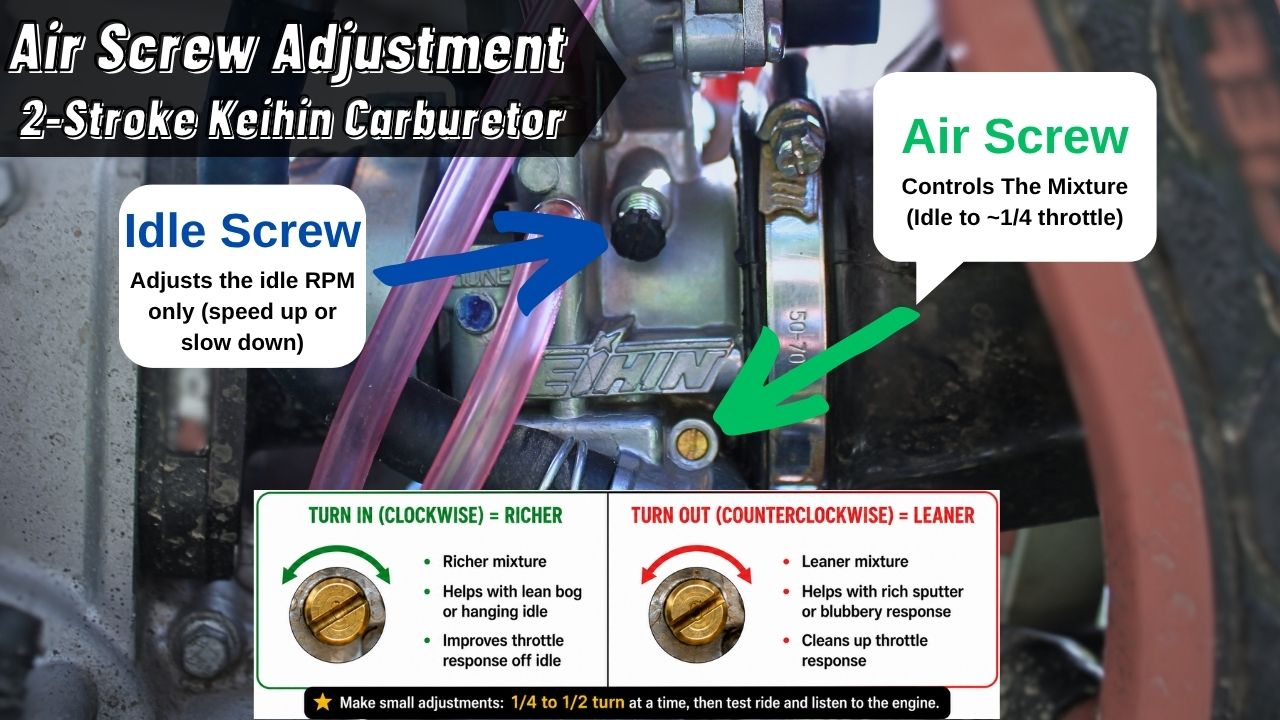
Keep in mind: The air screw only affects the mixture from idle to about ¼ throttle. If your bike only bogs at half throttle or full throttle, the problem might another carb circuit - not the air screw.
Here's a quick reference if you're not sure which direction to turn the air screw.
| Symptom | Turn Air Screw |
|---|---|
| Lean bog | Turn IN (Clockwise) |
| Hanging idle | Turn IN (Clockwise) |
| Rich sputter | Turn OUT (Counterclockwise) |
| Loads up | Turn OUT (Counterclockwise) |
| Poor throttle response off idle | Depends (Rich vs Lean) |
Pro Tip: I recommend making ¼-turn adjustments while you're close to the correct setting. If you're way off and can't tell much difference, compare the bike at ½ turn out versus 2½ to 3 turns out to quickly determine which direction you need to go.
Not sure whether your bike is actually rich or lean? Before turning the air screw, learn how to identify the difference by sound and throttle response in my Rich vs. Lean Dirt Bike Symptoms (How To Tell The Difference) guide.
When an Air Screw Adjustment Isn't Enough
If you've adjusted the air screw several times and your bike still doesn't start easily, idle smoothly, or respond crisply off idle, don't keep turning the screw and hoping for a different result.
The air screw is designed to fine-tune the pilot circuit—it isn't meant to compensate for an incorrectly sized pilot jet or another mechanical problem.
If you're wondering how the pilot jet, needle, main jet, and air screw all work together, learn how the different carb circuits affect your engine in my 2-Stroke Dirt Bike Carb: How It Works article.
A good rule of thumb is to have the air screw adjusted somewhere around 1 to 2 turns out from lightly seated. This gives you room to make small adjustments as the weather changes throughout the riding season.
If the bike runs best with the air screw less than 1 turn out, the pilot jet is usually too small (lean). Turning the air screw in richens the mixture, but if you have to nearly close it to make the bike run correctly, it's a good indication that the pilot jet itself needs to be richer.
On the other hand, if the bike only runs well with the air screw more than about 2½ to 3 turns out, the pilot jet is usually too large (rich). Opening the air screw lets in more air to lean the mixture, but once you're several turns out, you've reached the practical limit of the adjustment.
Think of the air screw like the fine adjustment on a microscope. It lets you make small corrections, but if the image is way out of focus, you need to adjust the main focus first. The same idea applies here—the pilot jet gets you close, while the air screw fine-tunes the mixture.
It's also worth remembering that not every low-throttle symptom is caused by jetting. I've worked on plenty of bikes where riders were convinced they needed different jets, but the real problem turned out to be something else entirely, such as:
- A clogged pilot jet or carburetor passage
- An air leak at the intake boot or crank seals
- Old or contaminated fuel
- A sticking float or incorrect float height
- Worn reeds (2-strokes)
- Tight valves (4-strokes)
- Low engine compression
That's one of the biggest reasons I recommend diagnosing the symptom before changing parts. The more accurately you can identify whether your bike is rich, lean, or has a mechanical problem, the faster—and cheaper—you'll solve it.
If your bike only runs correctly with the air screw nearly closed or more than about 2½ to 3 turns out, the air screw has reached the limit of its adjustment. At that point, it's time to change the pilot jet rather than continue turning the screw. I explain exactly how to determine the correct pilot jet size and replace it in my How to Easily Adjust the Pilot Jet on a Dirt Bike Carb guide.
Common Air Screw Adjustment Mistakes
Even a simple air screw adjustment can be misleading if you don't do it correctly. Here are some of the most common mistakes I see riders make.
1. Adjusting the Air Screw Before the Engine Is Warm
A cold engine always needs a richer fuel mixture to run properly. If you adjust the air screw before the engine reaches normal operating temperature, you'll likely end up with the wrong setting once it's fully warmed up.
Always ride the bike for several minutes before making any adjustments.
2. Making Large Adjustments
Turning the air screw one or two full turns at a time makes it difficult to tell what actually improved or made the bike run worse.
Instead, make changes in ¼-turn increments once you're close to the correct setting. If you're way off and can't tell much difference, compare settings that are farther apart (such as ½ turn versus 2½ to 3 turns out) to quickly determine which direction you need to go.
3. Ignoring the Idle Speed
Every time you change the air screw, the idle speed may change slightly as well. If the idle becomes too high or too low, use the idle speed screw to bring it back to a normal idle before continuing your adjustments.
4. Trying to Fix Every Problem with the Air Screw
The air screw only affects the mixture from idle to about ¼ throttle. If your bike bogs at half throttle, lacks top-end power, or fouls spark plugs no matter where the air screw is set, another carb circuit—or even a mechanical problem—is likely the real cause.
The goal isn't to find a "magic" air screw setting. It's to use the air screw as a fine-tuning tool after the rest of the carburetor is working correctly.
Frequently Asked Questions
How many turns out should a 2-stroke air screw be?
Most 2-stroke dirt bikes run best with the air screw set somewhere around 1 to 2 turns out from lightly seated. However, there isn't one setting that's correct for every bike. The ideal position depends on your pilot jet size, temperature, elevation, humidity, fuel, and engine modifications.
Use the air screw to find the setting that provides the easiest starting, smoothest idle, and crispest throttle response off idle.
Which way do you turn a 2-stroke air screw to make it richer?
Turn the air screw clockwise (in) to make the mixture richer.
Turn it counterclockwise (out) to make the mixture leaner.
This is the opposite of a 4-stroke fuel screw, which is why many riders get confused.
Still not sure whether your carb has an air screw or a fuel screw? Watch this short video.
What happens if the air screw is too rich?
If the air screw is adjusted too rich, your bike may:
- Load up at idle
- Sputter or blubber when you open the throttle
- Feel sluggish off idle
- Produce more exhaust smoke or oil from the silencer on a 2-stroke
If turning the air screw out doesn't solve the problem, the pilot jet may be too rich.
What happens if the air screw is too lean?
A lean air screw setting can cause:
- A lean bog or hesitation when opening the throttle
- Hanging or racing idle
- Hard starting when warm
- Poor throttle response off idle
If the bike only runs correctly with the air screw nearly closed, you'll likely need a richer pilot jet.
Why doesn't adjusting the air screw make a difference?
If turning the air screw has little or no effect, one of several things may be happening:
- The pilot jet is the wrong size.
- The pilot jet or carburetor passages are clogged.
- The air screw passage is blocked.
- The float height is incorrect.
- The bike has an air leak.
- Another carb circuit is causing the symptom.
When the air screw doesn't noticeably change how the engine runs, it's usually a sign to stop adjusting and start diagnosing the underlying problem instead.
Can I damage my engine by adjusting the air screw?
No. The air screw is a fine-tuning adjustment for the idle and low-throttle mixture, so you're very unlikely to damage your engine simply by turning it in or out while tuning.
However, if your engine is running extremely lean because of incorrect jetting or another problem, continuing to ride it hard can eventually cause engine damage. That's why it's important to identify whether your symptoms are caused by the air screw, the pilot jet, another carb circuit, or a mechanical issue before making major changes.
Ready to Stop Guessing?
Adjusting your air screw is one of the easiest ways to improve how your 2-stroke starts, idles, and responds off idle - but it's only one small part of tuning your carburetor.
If you're still guessing which jet to change, wondering whether your bike is running rich or lean, or changing parts without knowing if they'll actually solve the problem, you're not alone. That's exactly why I created 2-Stroke Jetting Made Easy.
Instead of teaching you one carb adjustment at a time, I'll show you the complete Sounds & Symptoms Diagnosis System so you know exactly what to adjust before buying another jet.
| This article | 2SJME Course |
|---|---|
| ✅ How to adjust the air screw | ✅ Diagnose almost any jetting symptom |
| ✅ Improve idle and off-idle response | ✅ Know which carb circuit to adjust first |
| ✅ Fine-tune one adjustment | ✅ Complete Sounds & Symptoms Diagnosis System |
| ✅ Free article | ✅ Step-by-step video course |

David Riggs
Saturday 17th of June 2023
Great explanation. I have been adjusting the pilot jet in a LT250R that I rebuilt from a basket case. The off the shelf carburetor rebuild kit jet and the Clymer manual call for a 45 pilot. After review online this model number should have a 30. You explanation helped me dig deeper to solve my idle to 1/4 throttle problem.
Kelley Fager
Monday 19th of June 2023
So glad you were able to solve your problem, David!
Eugenio
Friday 24th of March 2023
Great article. Cheers from Italy
Kelley Fager
Friday 24th of March 2023
Thanks, Eugenio! What did you find most interesting?
G.Bova
Thursday 22nd of December 2022
Grr a *whole new not while sry..speed texting
G.Bova
Thursday 22nd of December 2022
If you just break down and buy a while new carb, does it still need to be jetted right away?
Kelley Fager
Thursday 22nd of December 2022
Most likely, it will need some tuning/adjusting if you want it to run best, especially if it didn't come "pre-jetted" for your specific bike. What bike and what carb are you talking about here?
John F Di Fabrizio
Friday 16th of September 2022
This is the best explanation of tuning a Carburetor I have found on the web. Nice though process and great explanation on what to do! Thank you!
Kelley Fager
Monday 19th of September 2022
Wow, thanks for your kind words, John! My goal is to be as simple and helpful as possible. What did you find most interesting about my explanation?